Musings from Rome… pt. 3
Last Summer, my wife and I went on pilgrimage to Rome for the Jubilee Year. Here is our story…
The second half of the day was spent in the Vatican Museums. I cannot emphasize enough how overwhelming it is. You risk just walking through it all, because you can’t take it all in. My advice is: 1) Give it a respectful 1/2 day treatment, so that you can take breaks, go through twice, etc., in order to rest your mind and body so you can handle more; 2) Do a tour, of some type. This will force you to move slower and pay attention, as well as glean some great information you might not discover on your own; and 3) In each room, pick at least one thing, and force yourself to actually look at it, study it, and learn about it.
I’ve organized the galleries below into three: Statues, Artifacts, and Paintings. These aren’t all of the most famous ones (you can look those up online, with better photographers than me). Instead, these are ones that I was moved by. Feel free to click through and read the captions.
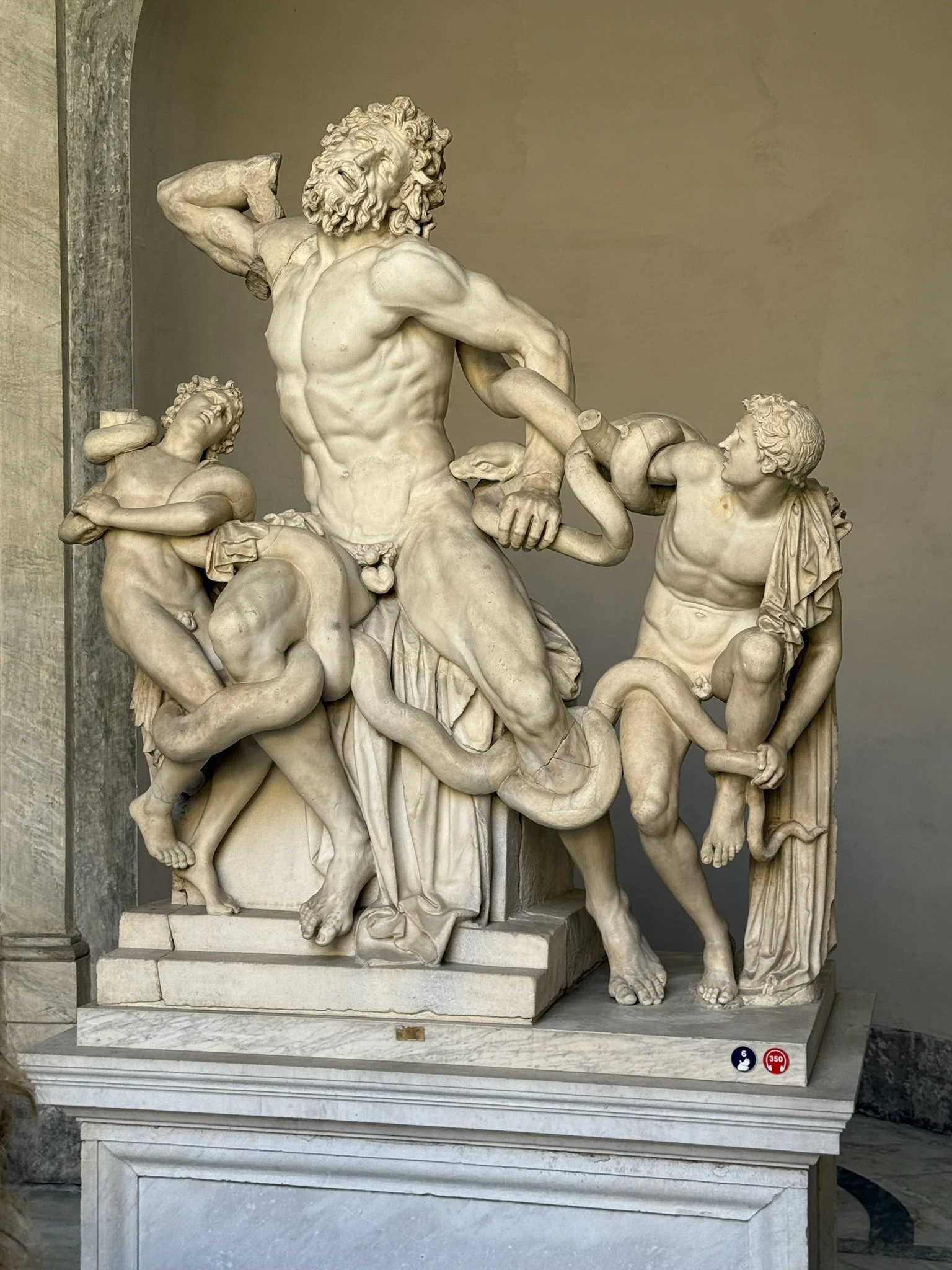
Excavated in 1506, unknown creation date. The figures are almost life-sized, showing a Trojan priest named Laocoon and his sons being killed by sea serpents. Some neat history: part of his arm was missing when discovered, and debate ensued regarding whether it was stretched out or bent. Archeologist Ludwig Pollak eventually discovered the arm, and it was restored.
What I love: I love how the sculptor(s) is able to show the expressions of pain and agony. It’s so real and visceral.
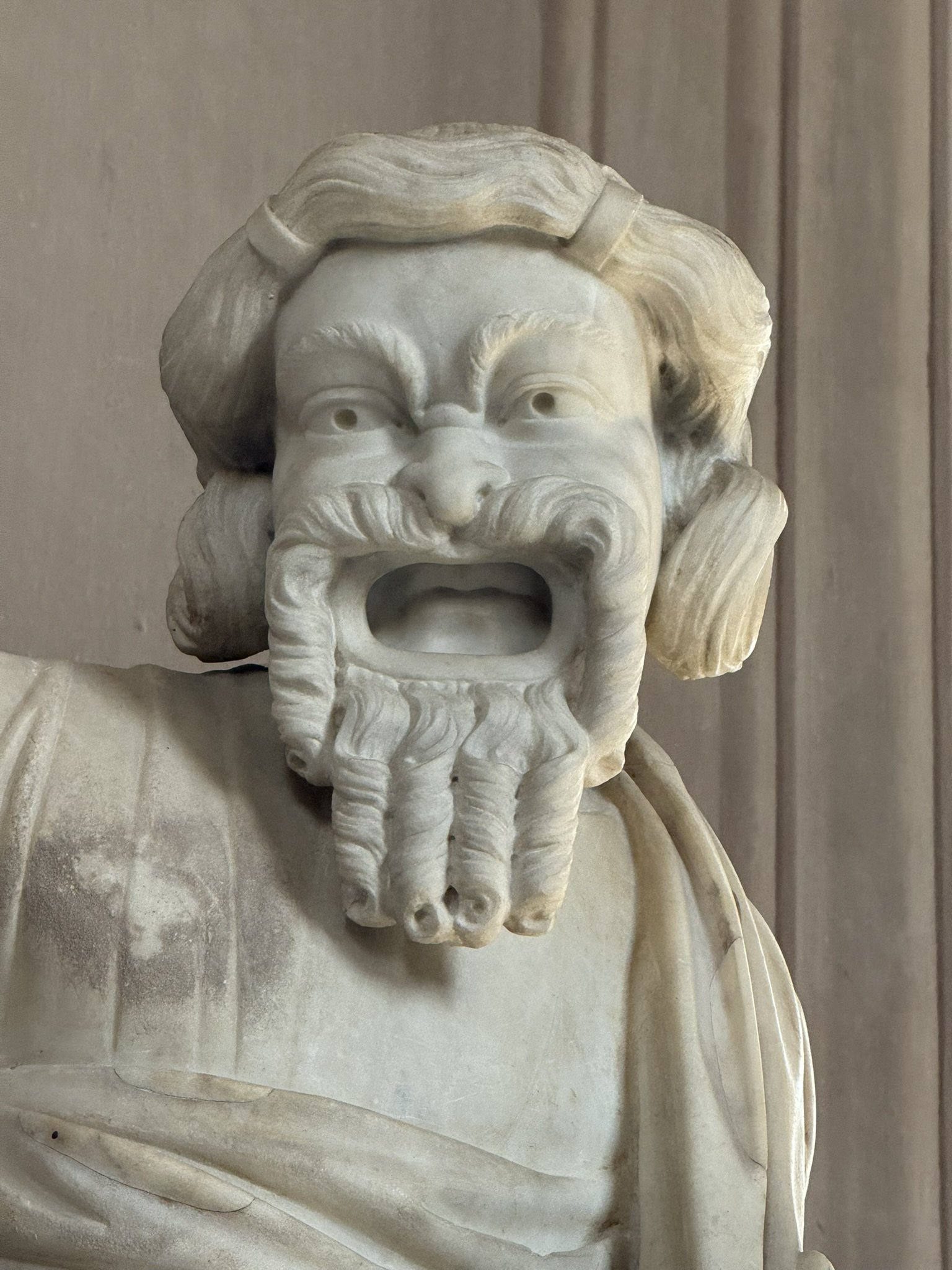
I don’t know the name of the piece, but it depicts an actor with a mask. All actors wore these masks, both to show their expressions to the audience and also to function like an amplifier (you can see around the mouth how it functions like a funnel).
What I love: It’s such an interesting idea, almost a sculpture within a sculpture. The work that had to go into creating the depth of the face beneath the mask is amazing.
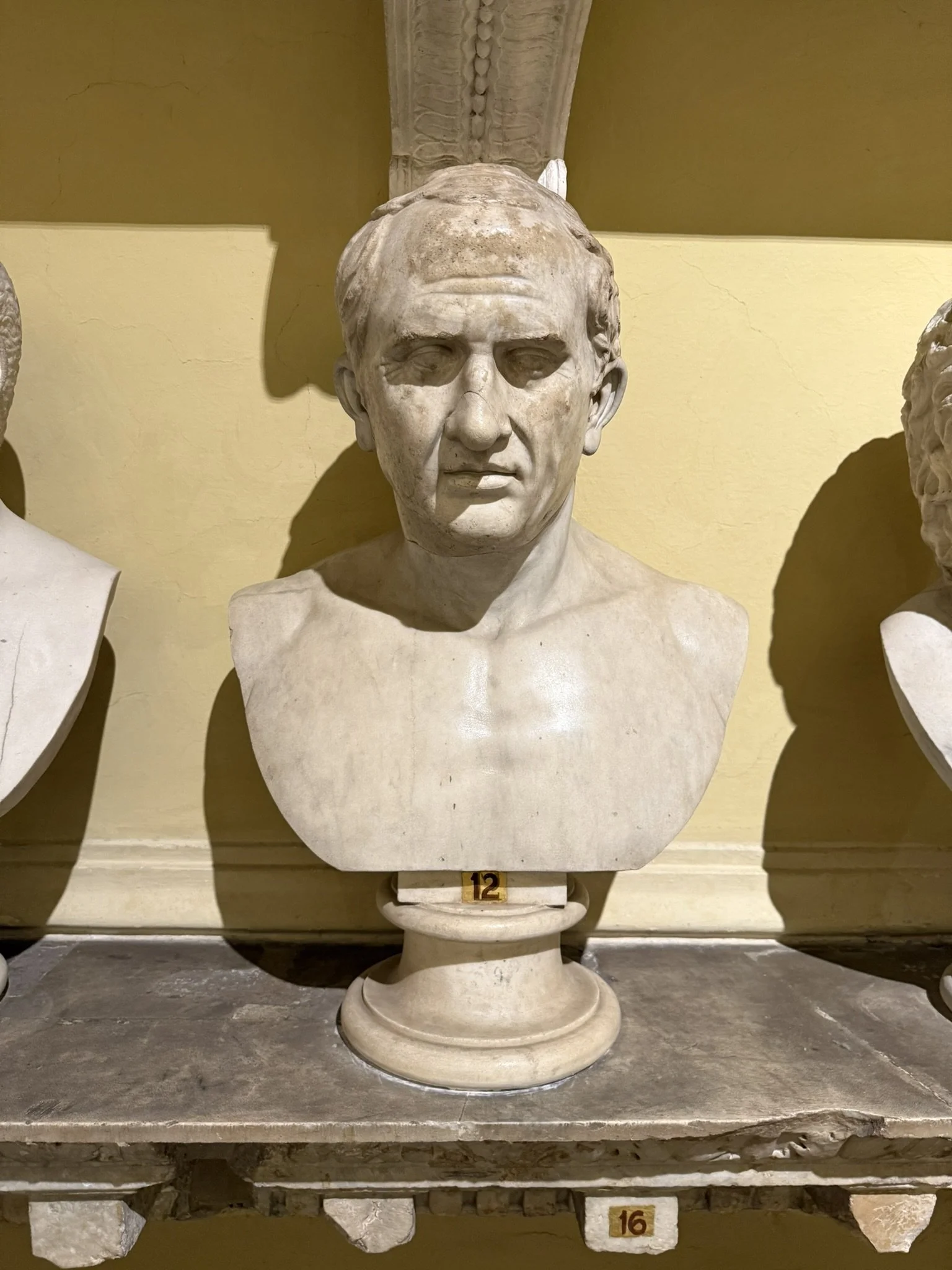
Well, maybe. It was originally believed to be Cicero because of an inscription, but some scholars now debate that. Either way, Cicero sometimes comes up in lessons I teach, so I like students to put a name to a face.
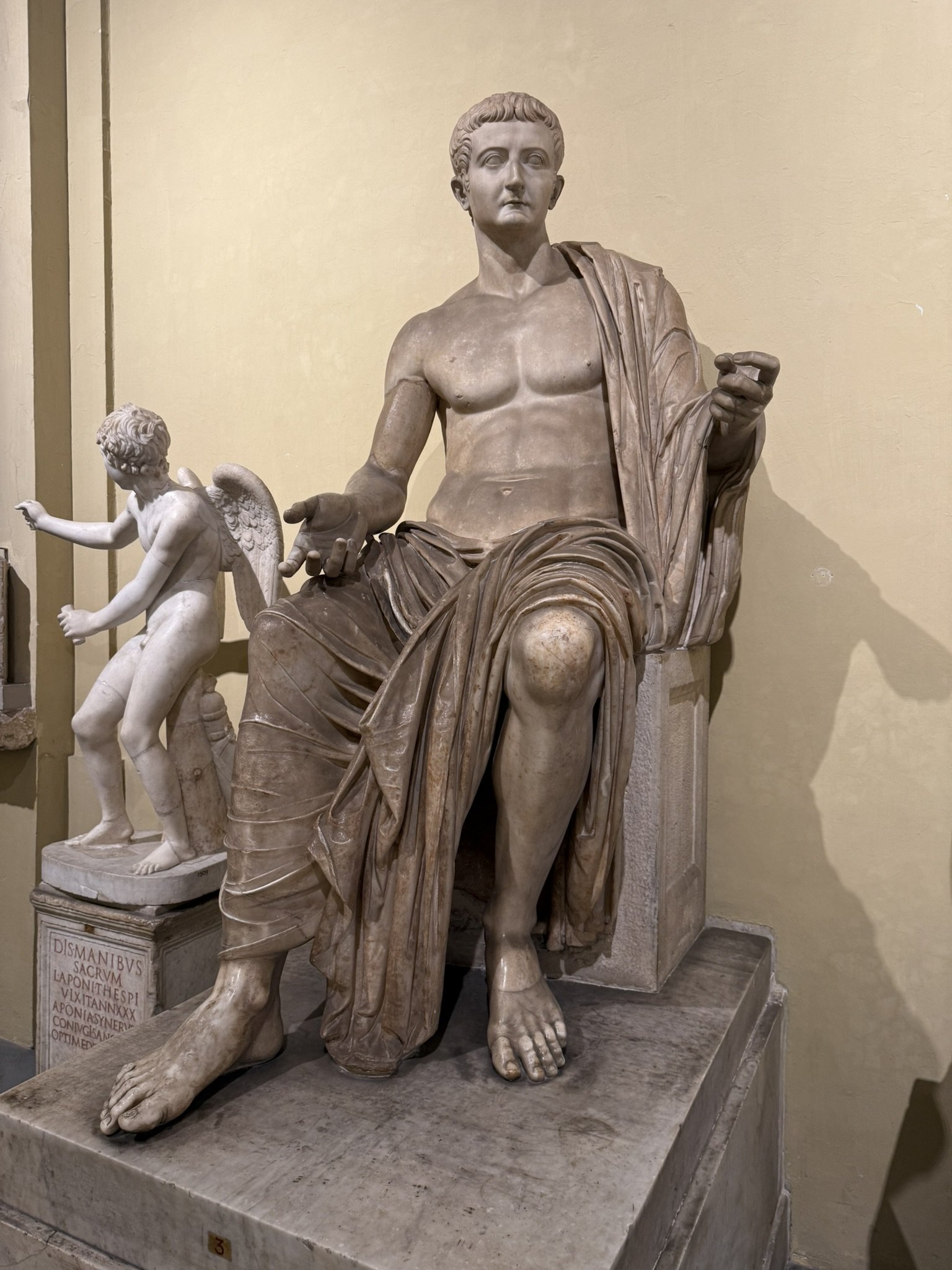
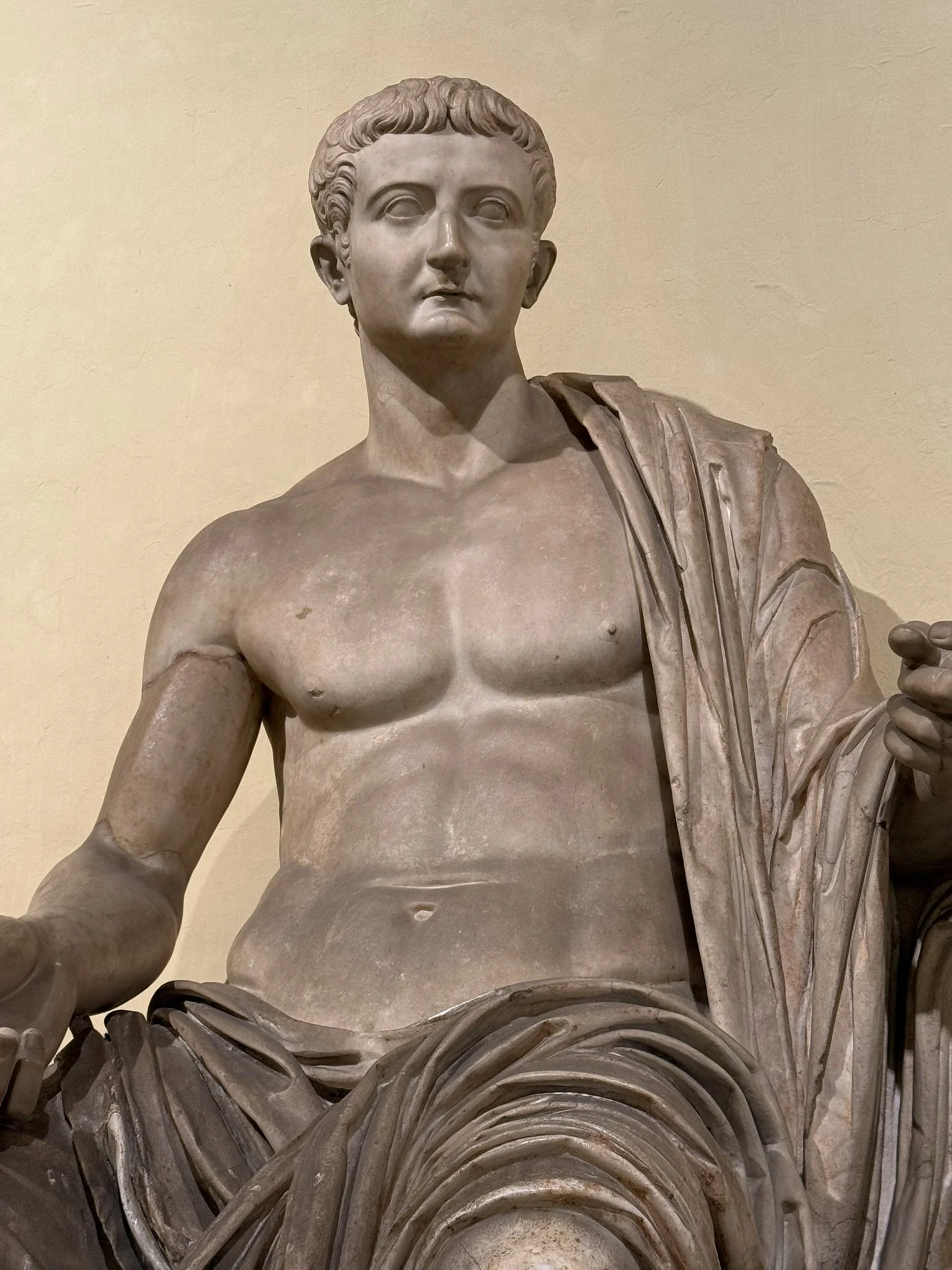
Dates to around 37 AD. Emperor Tiberius was emperor at the time of Christ’s death. Again, I like students to see a face, not just a name, when reading the Bible.
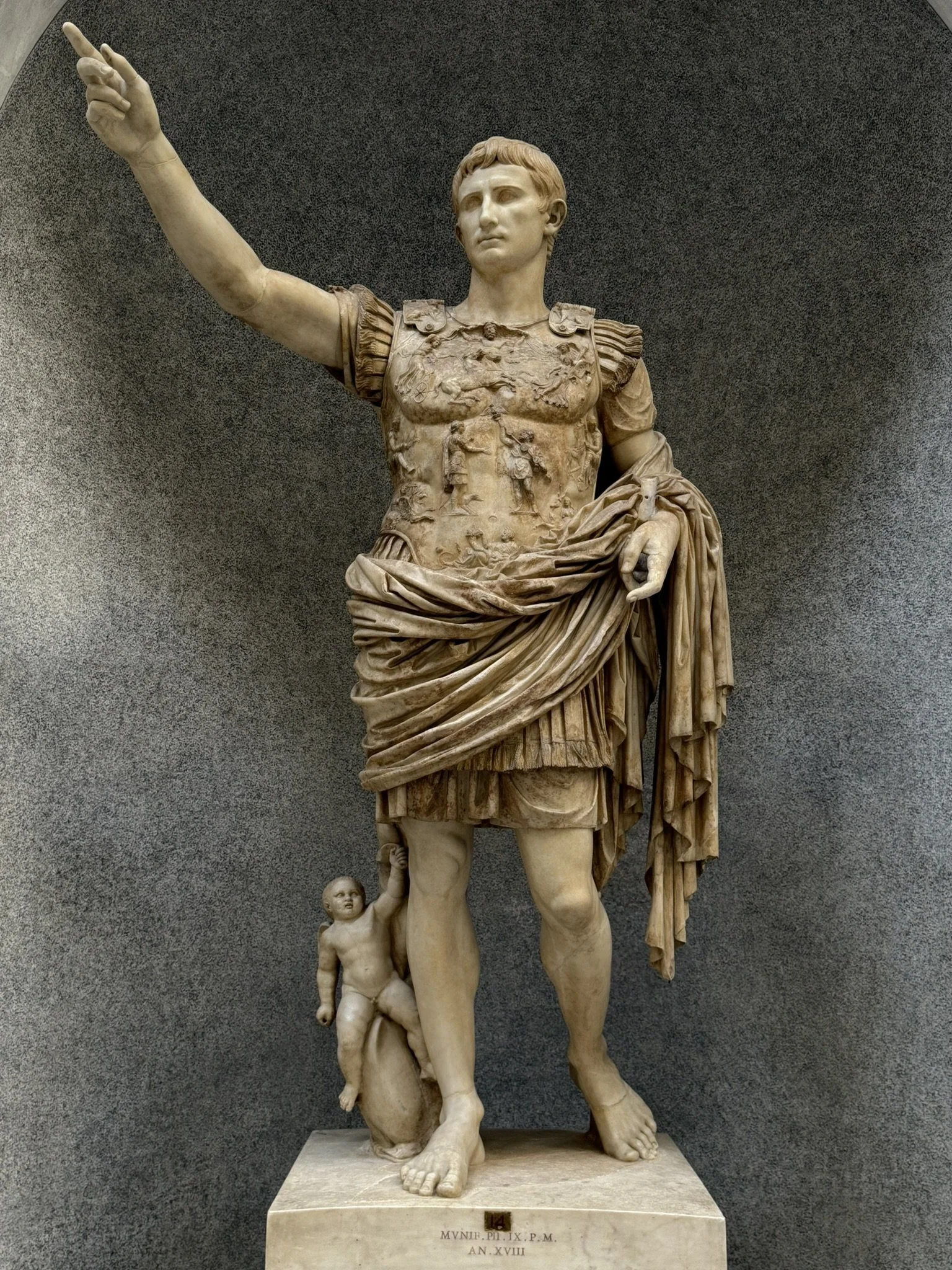
Created sometime around the beginning of the 1st Century AD. He was emperor at the time of Jesus’s birth.
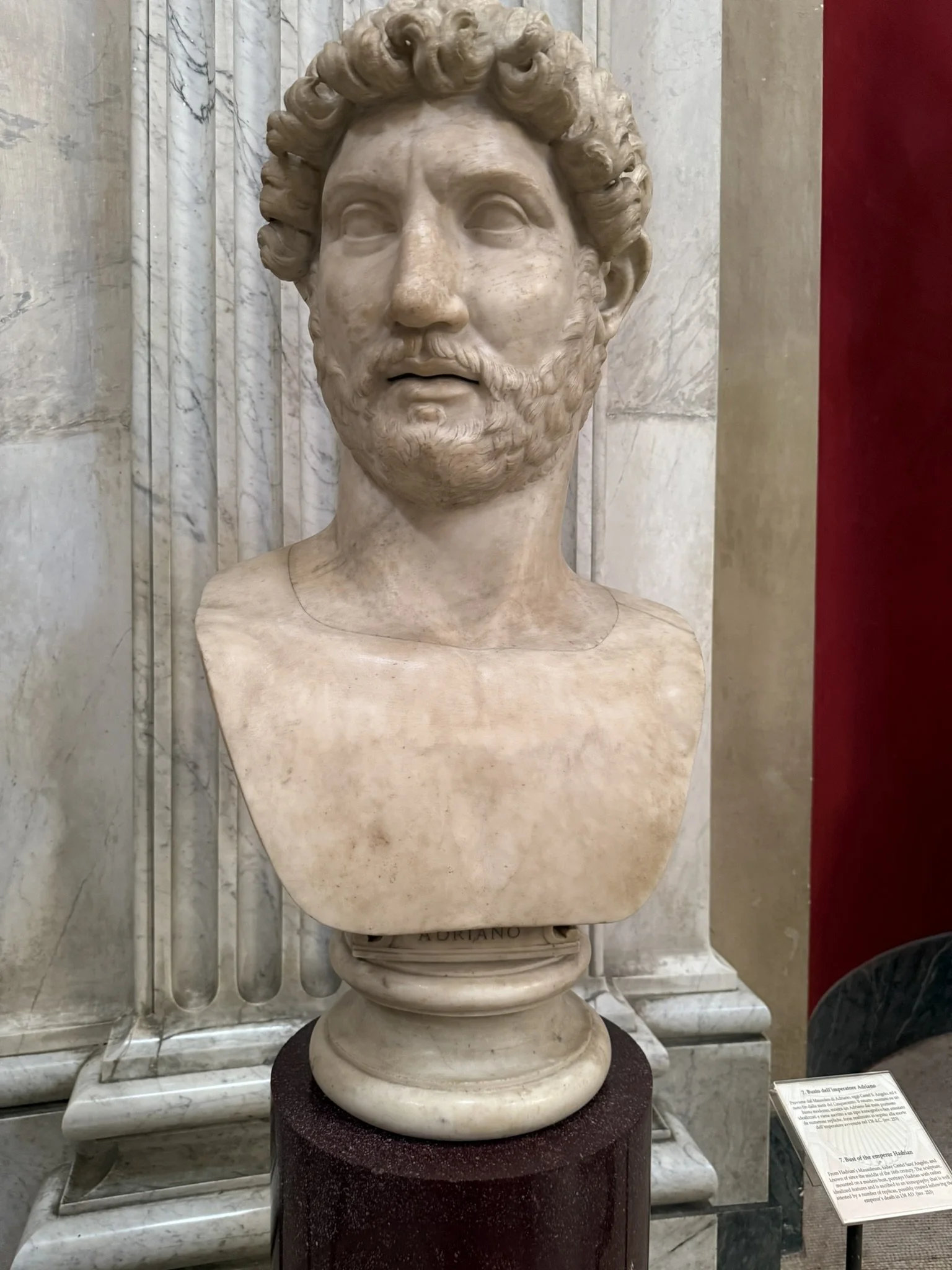
Emperor from 117-138 AD, Hadrian wasn’t that bad towards Christians. His policy was that they could only be punished for specific offenses, not merely for being Christian (although sometimes the results of being Christian meant you committed those offenses), and accusers of Christians had the burden of proof. He also built a cool wall over in the U.K.
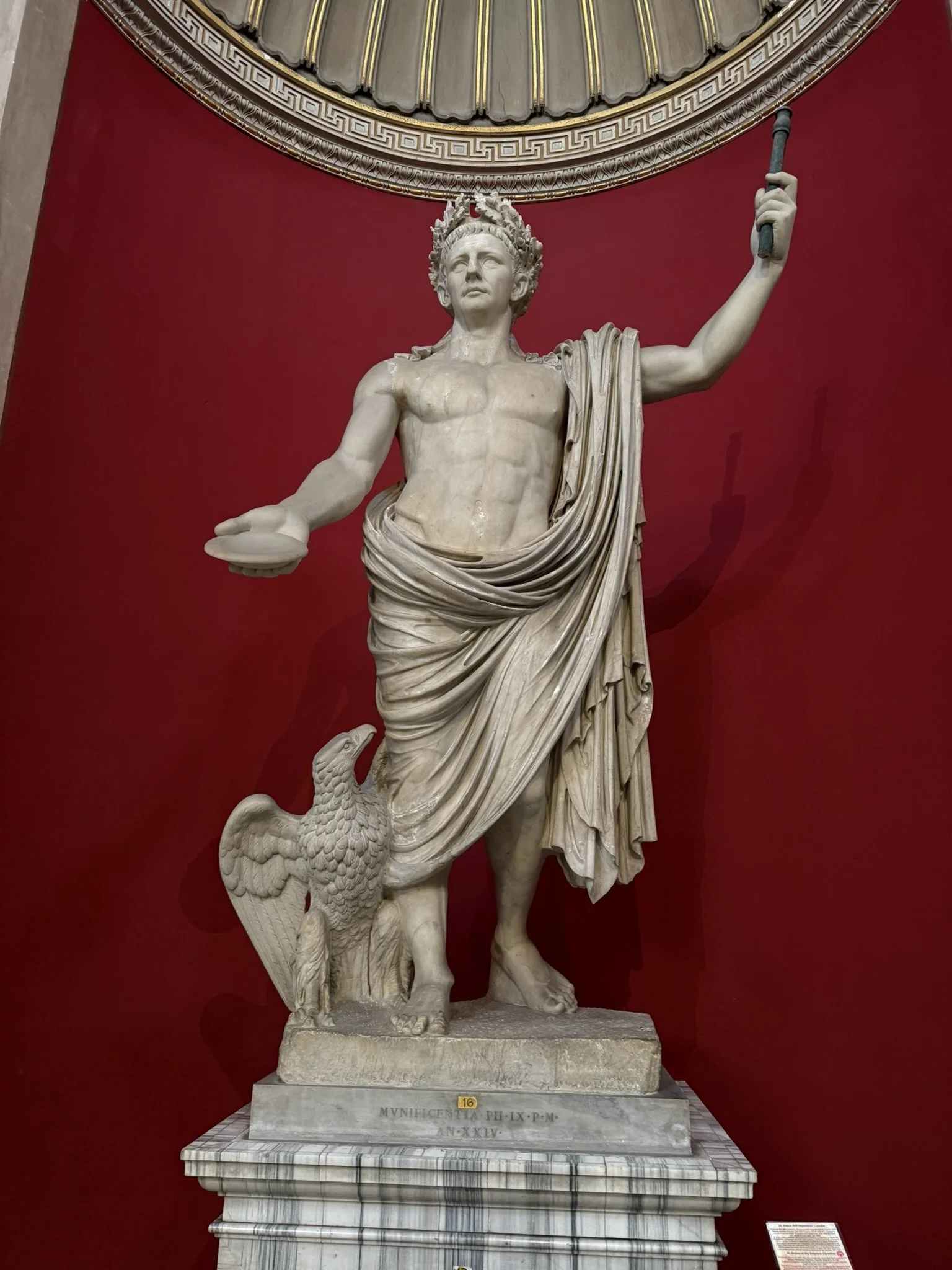
Claudius was emperor from 37 to 54 AD. Here, he is depicted as a god… specifically, the chief god Jupiter. Go big or go home, I guess.
Claudius was emperor from 41-54 AD, succeeded by Nero, his nephew. A lot of Acts occurs during his reign.
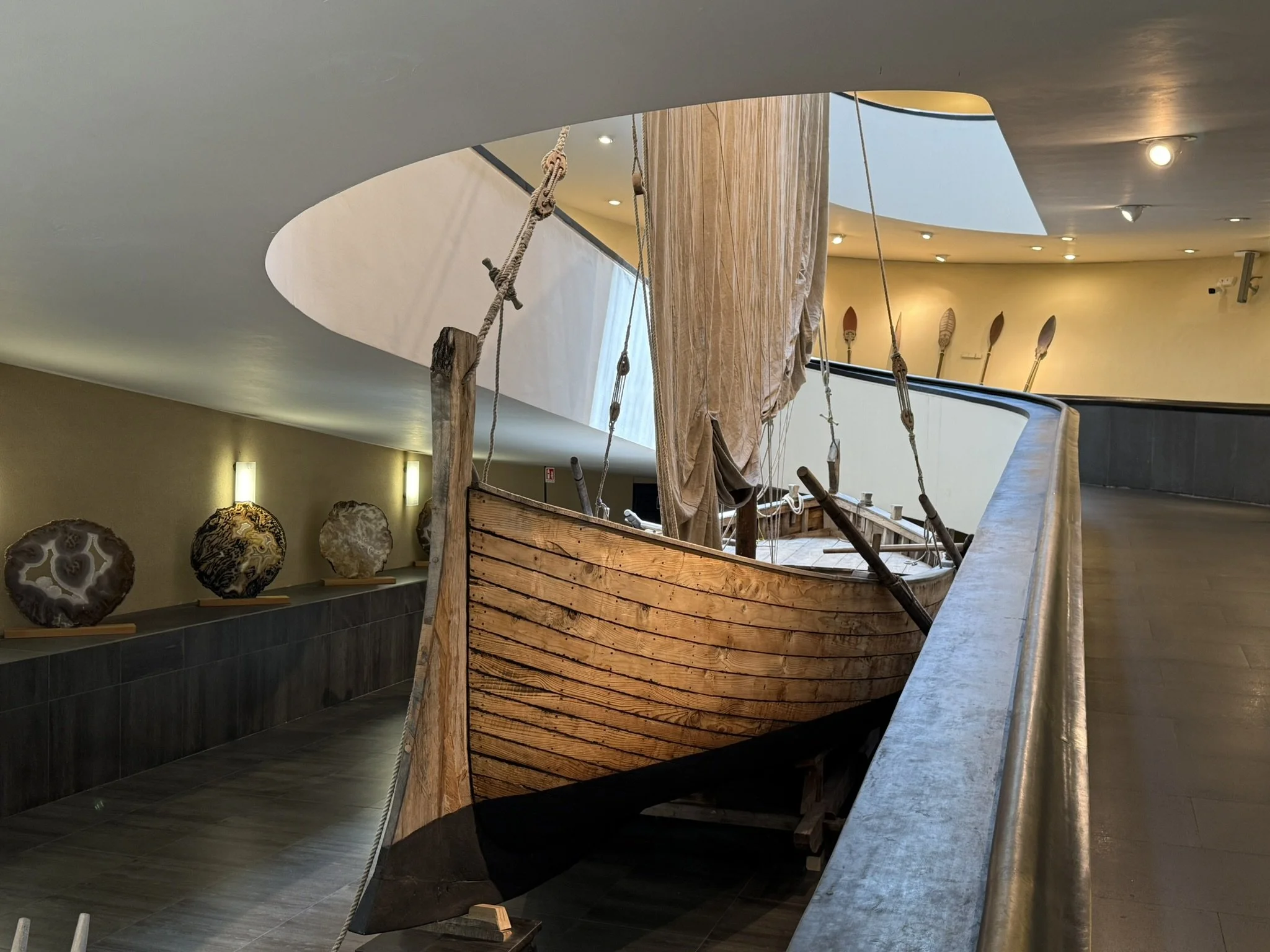
This is a replica of the type of ship St. Peter and Jesus would have sailed upon. Larger than one might think, yet clearly fragile enough that you wouldn’t want to be at sea in a storm in this thing.
The Church is sometimes referred to as the Barque of St. Peter, wherein we are sailing with St. Peter as our captain, journeying towards Jesus and heaven.
Many churches are built to remind you of an upside down ship from the inside, which is why those ceilings curve towards the center like the bottom of a boat.
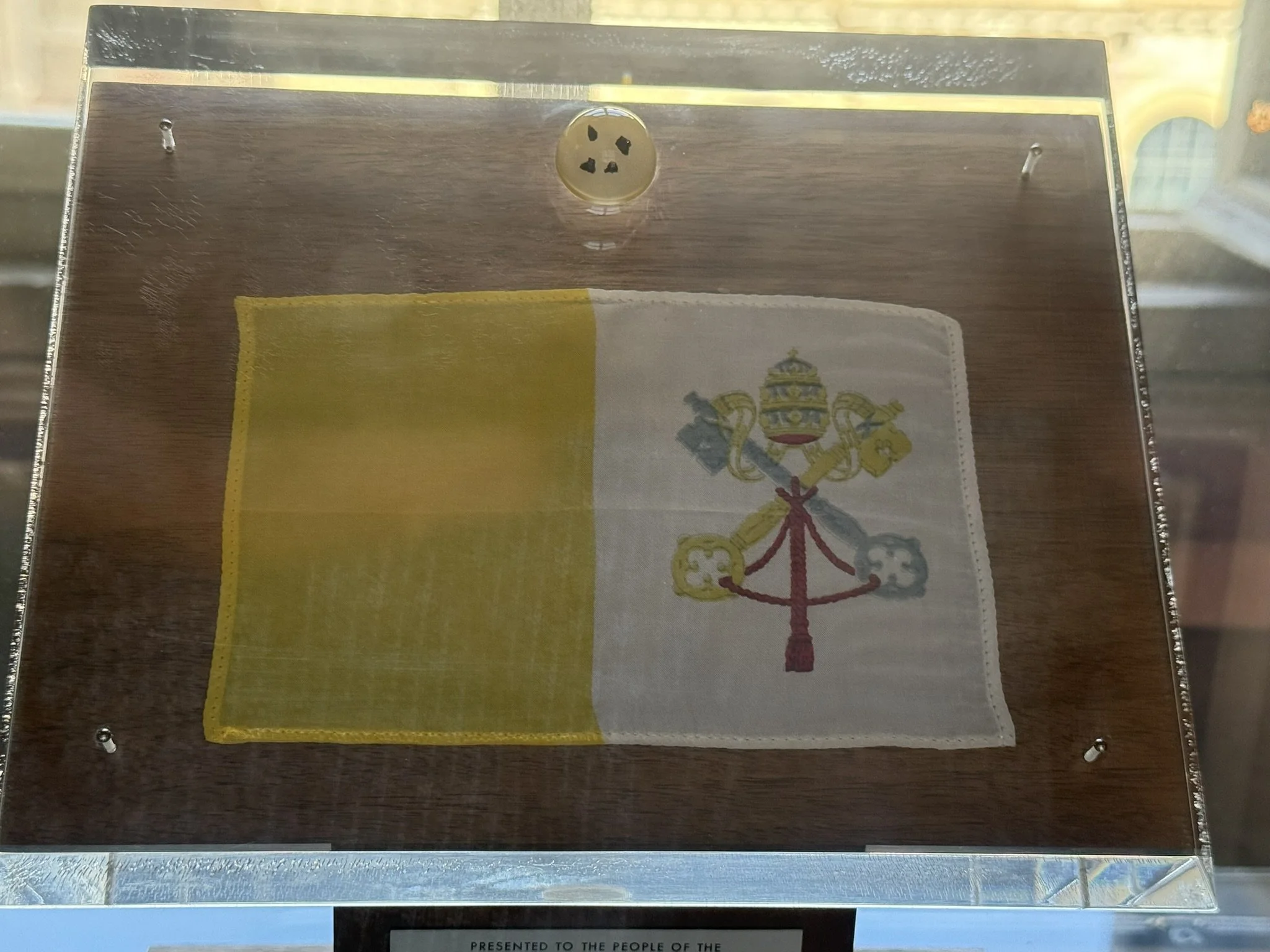
Richard Nixon gave this flag to the Vatican, after it was brought to the moon. You’ll also notice small moon fragments in the bubble at the top of the image. From Apollo 11.
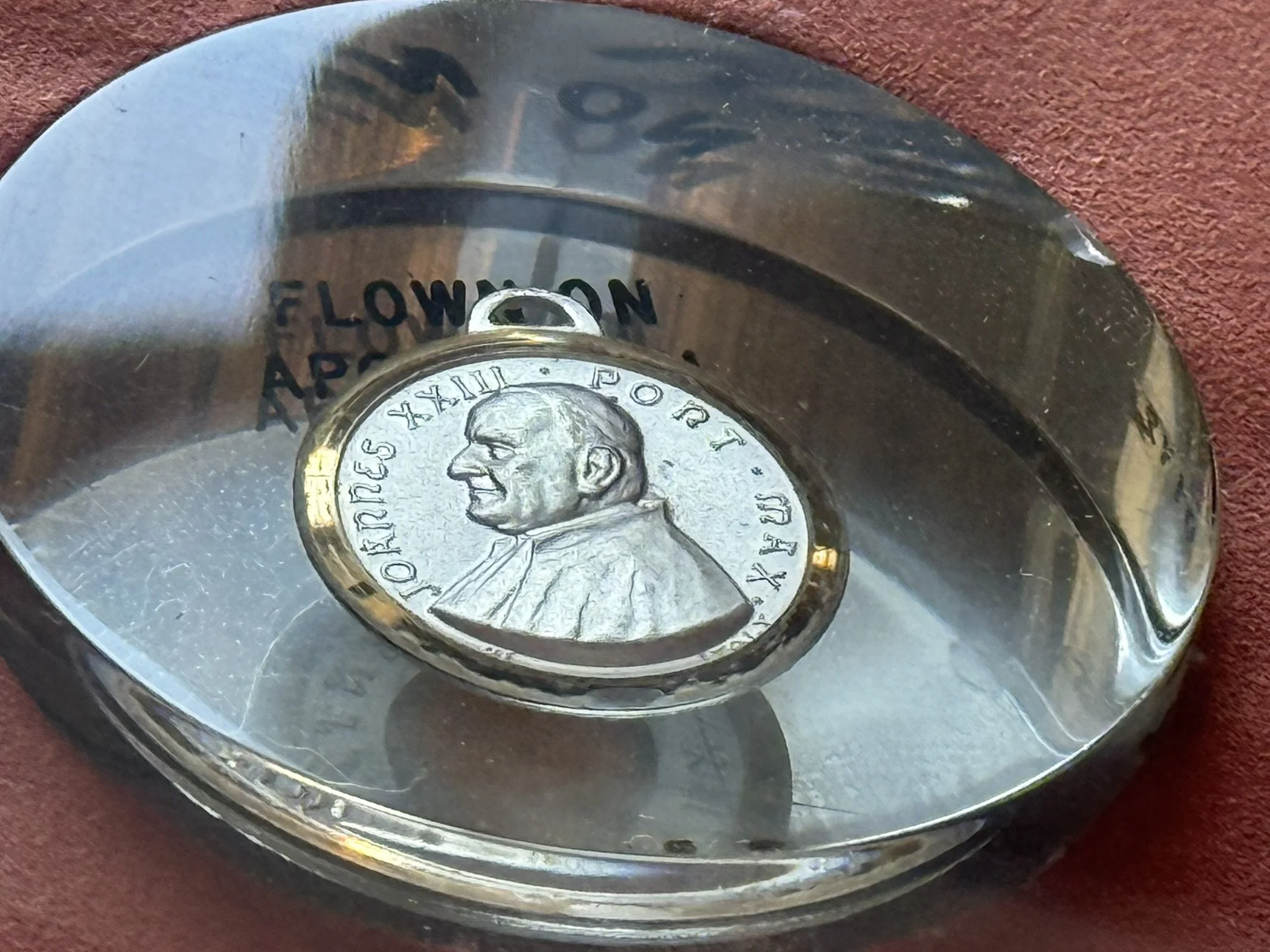
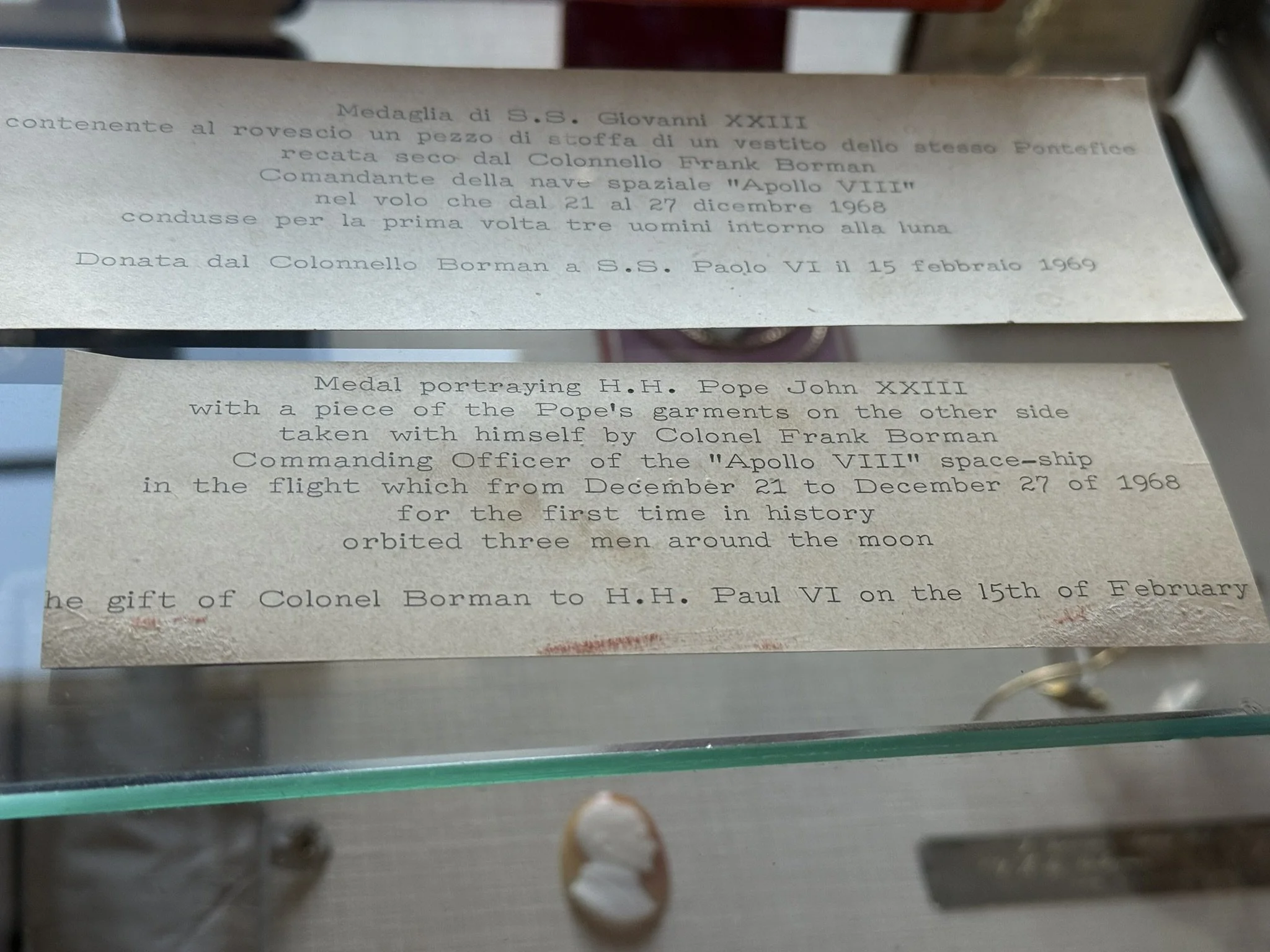
Likewise from the Apollo VIII mission. It has a piece of the Pope’s clothing on the other side, and went in the flight that orbited three men around the moon. It was given to Pope Paul VI.
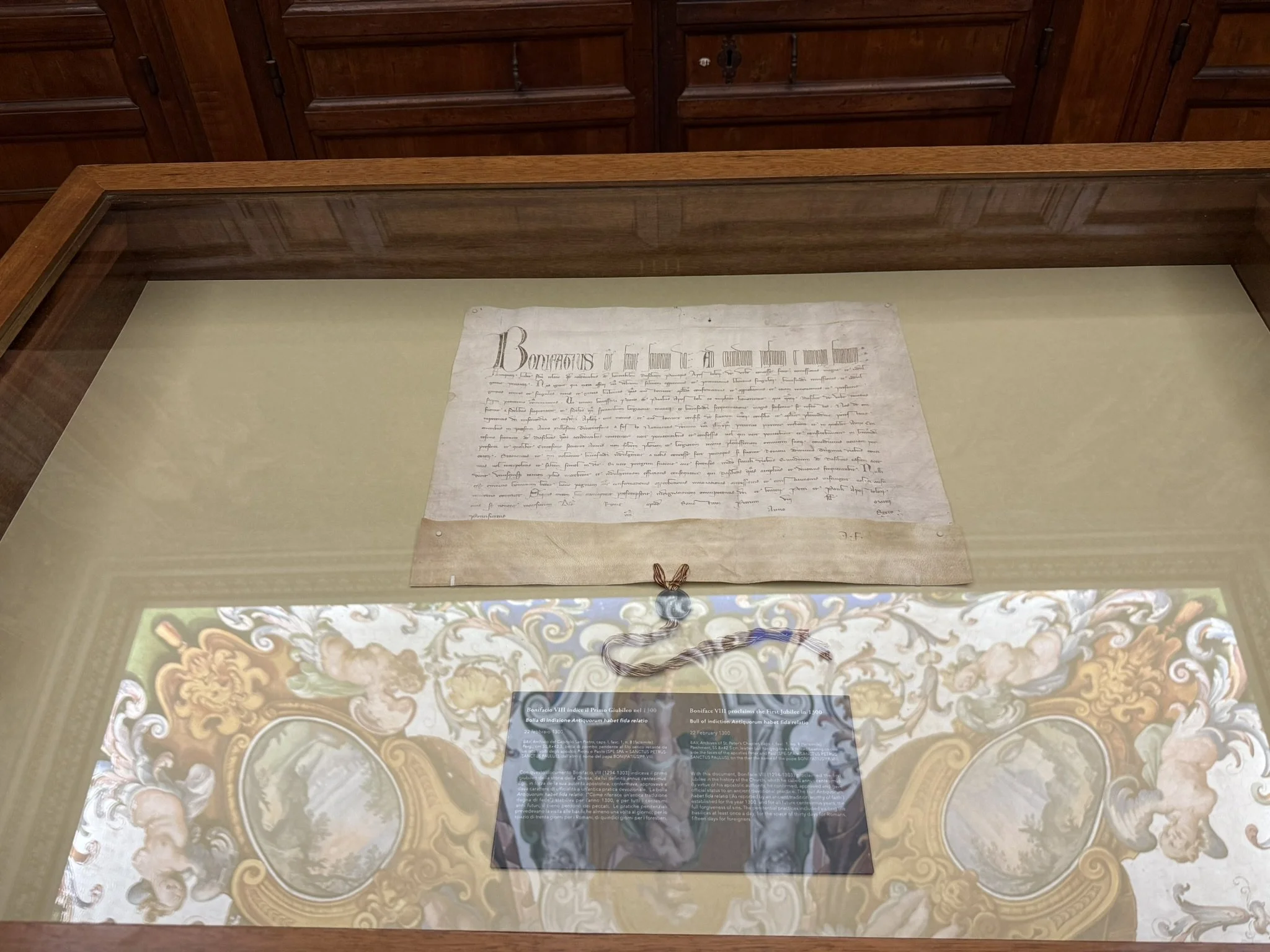
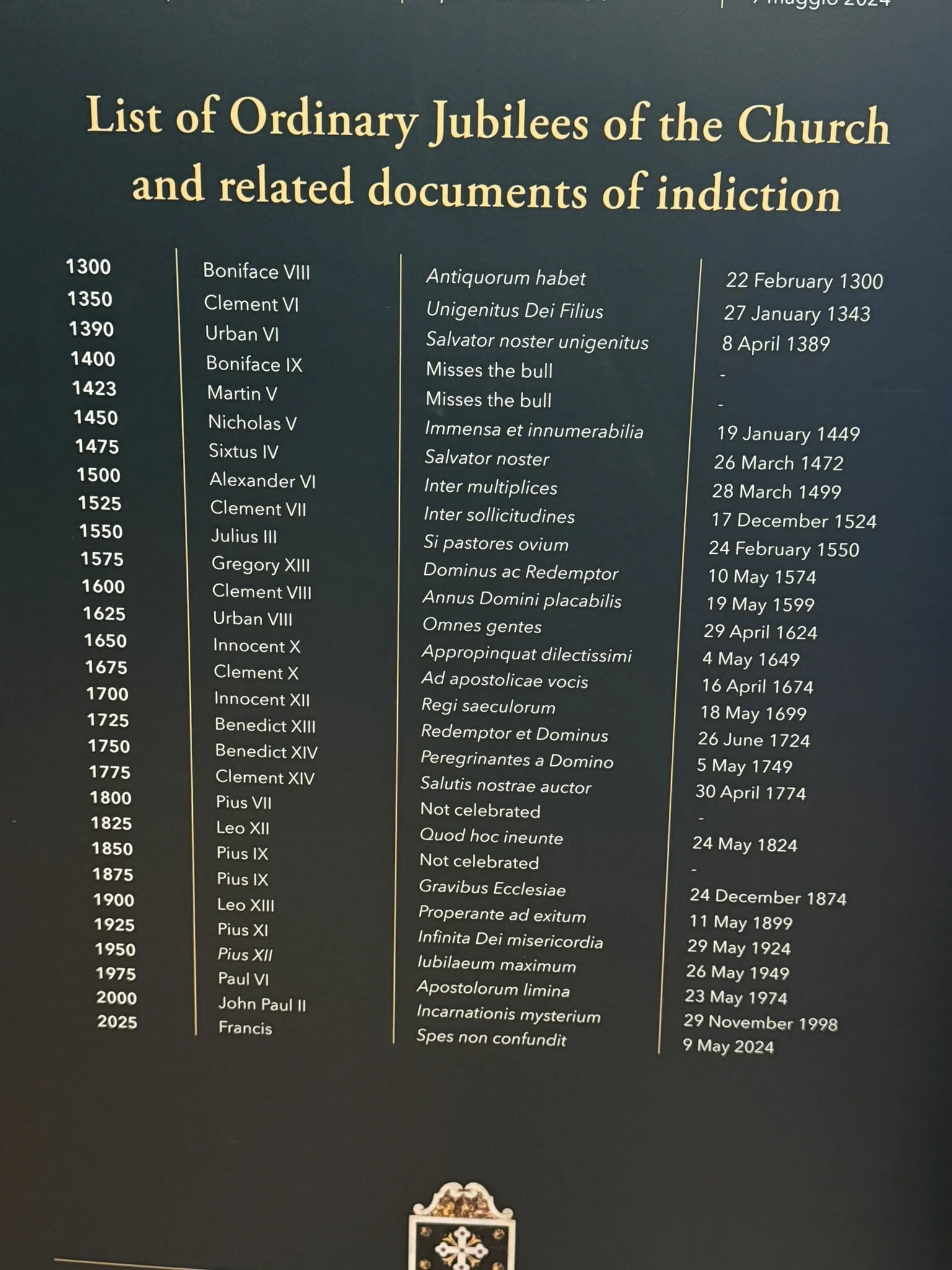
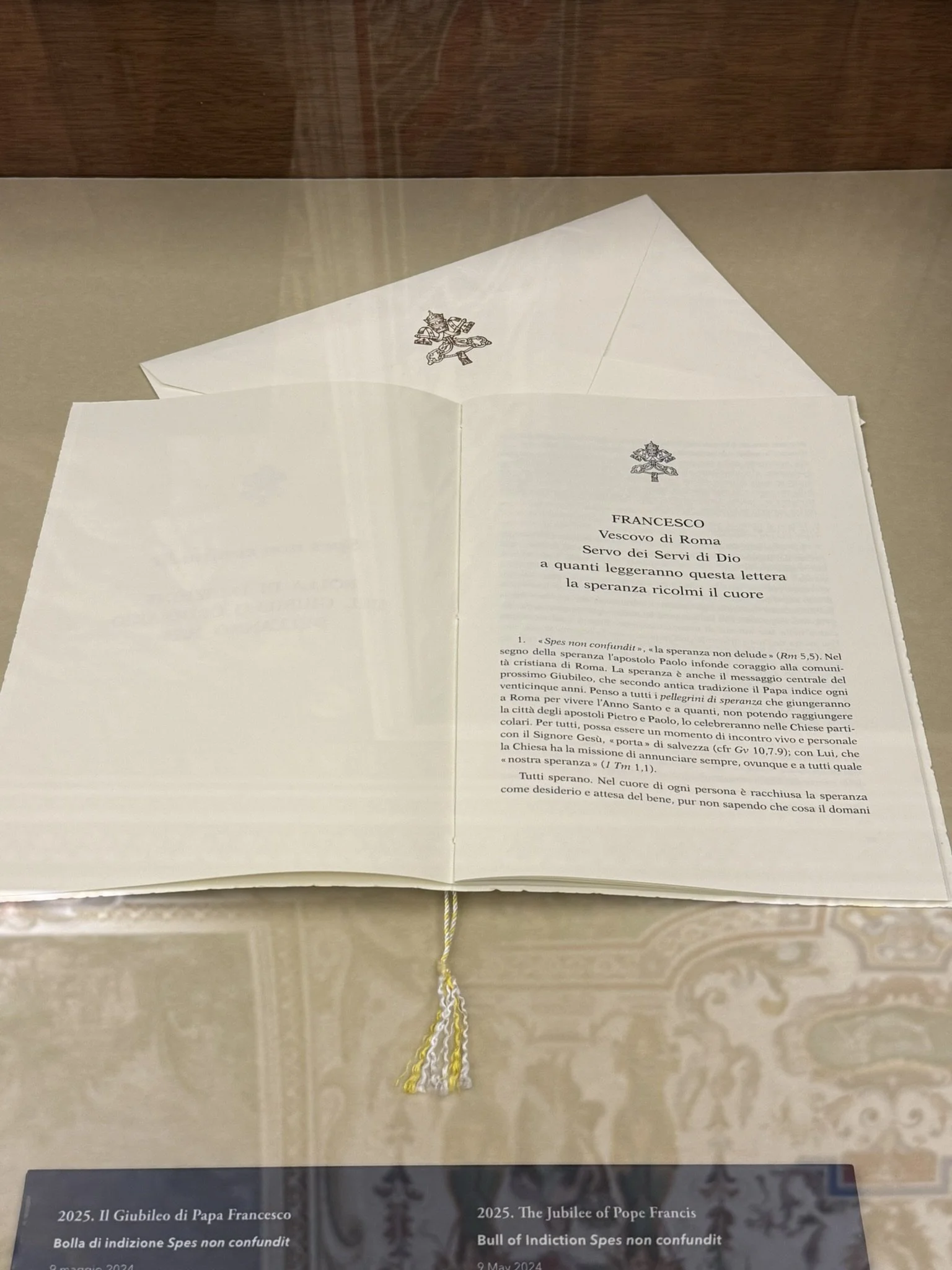
This is the bull which invoked the 2025 Jubilee Year, by Pope Francis.
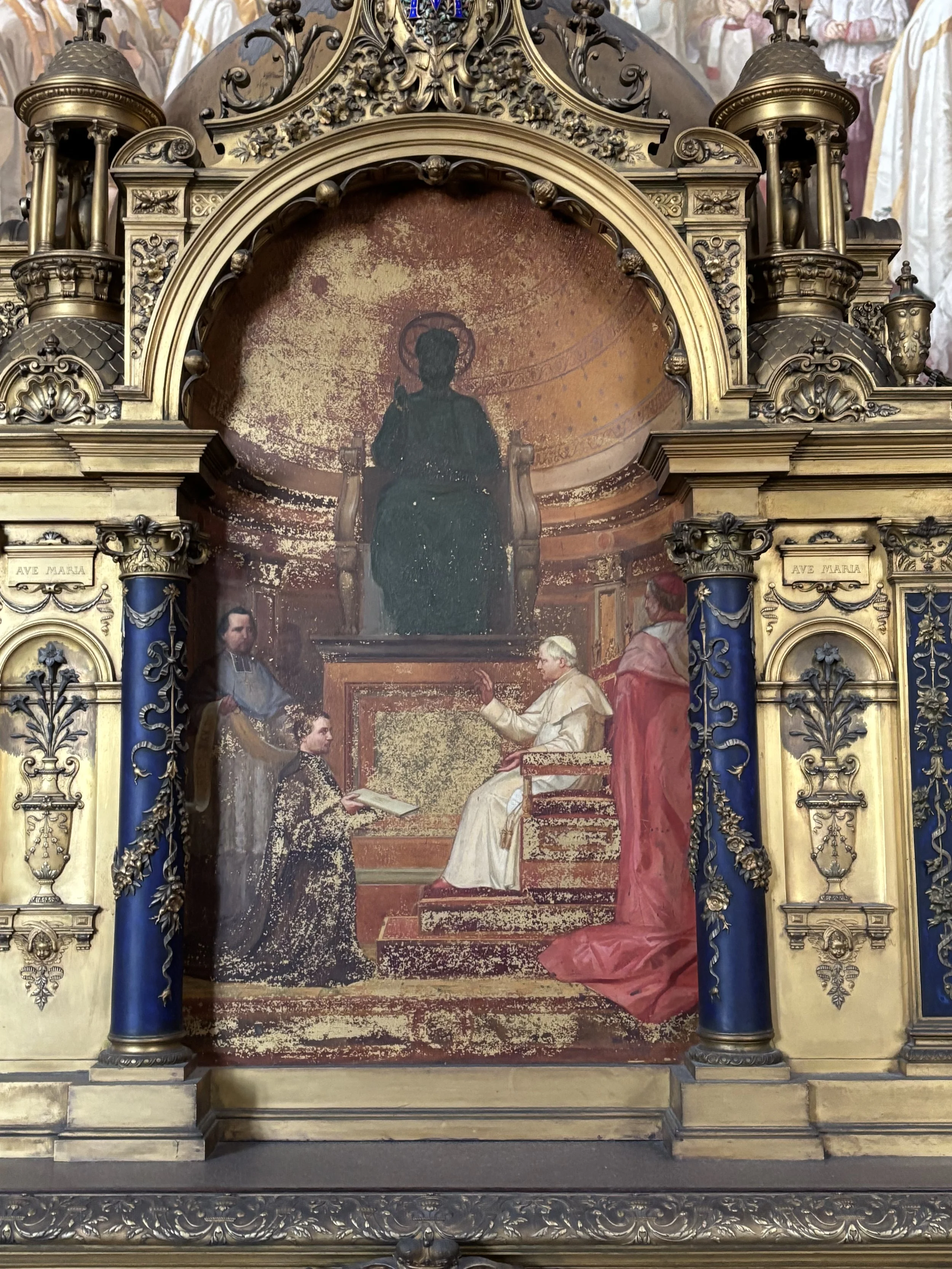
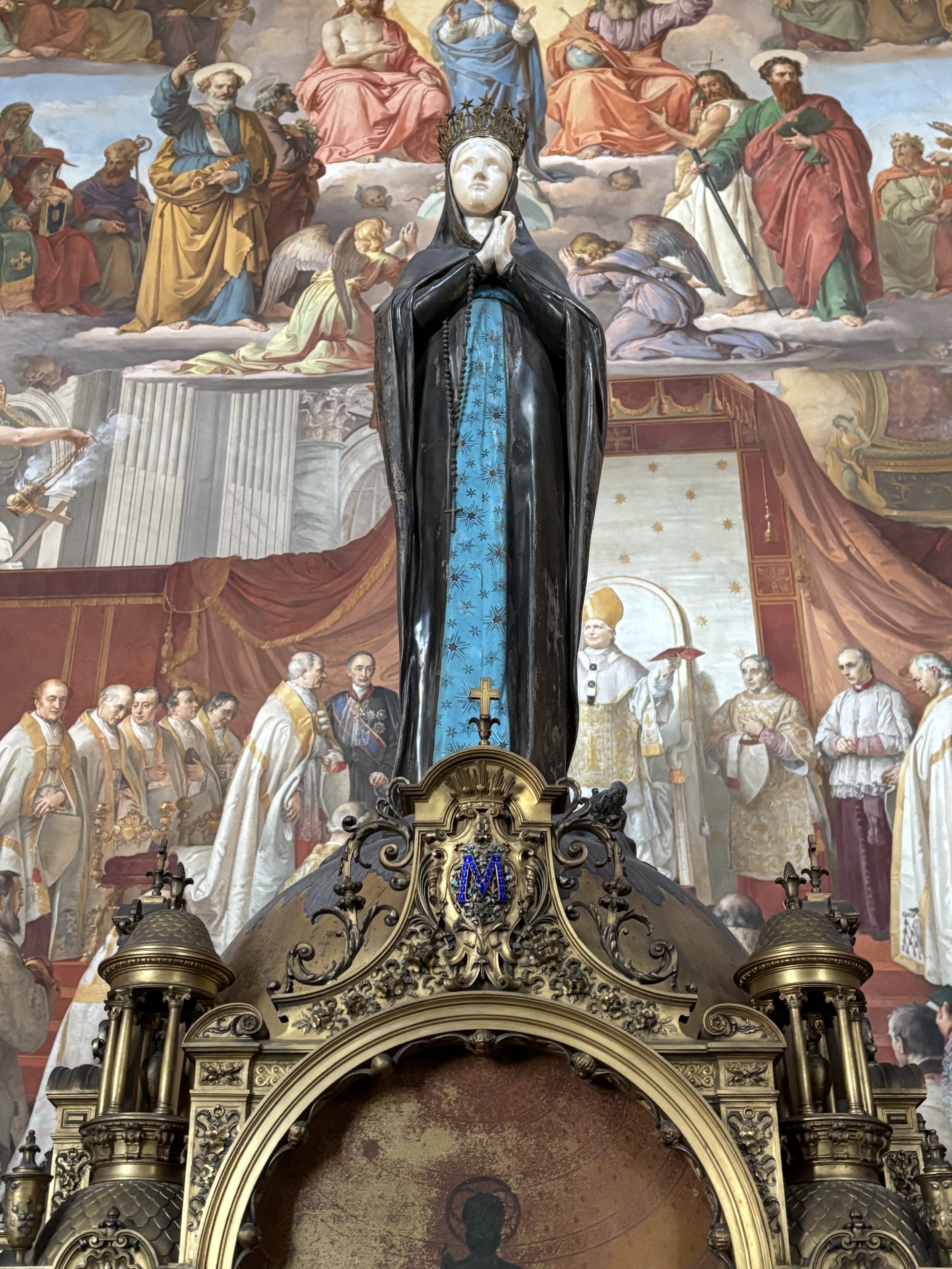
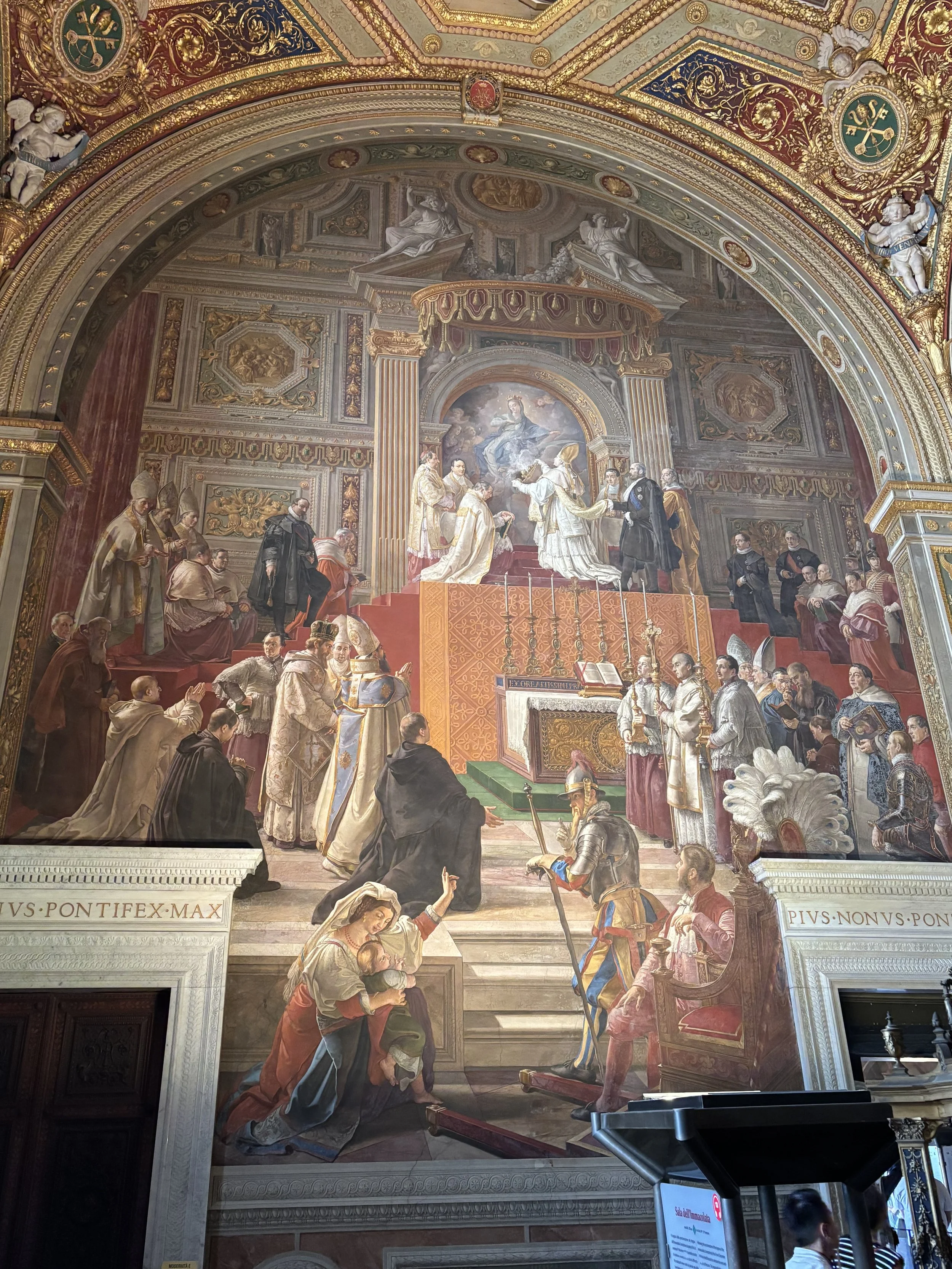
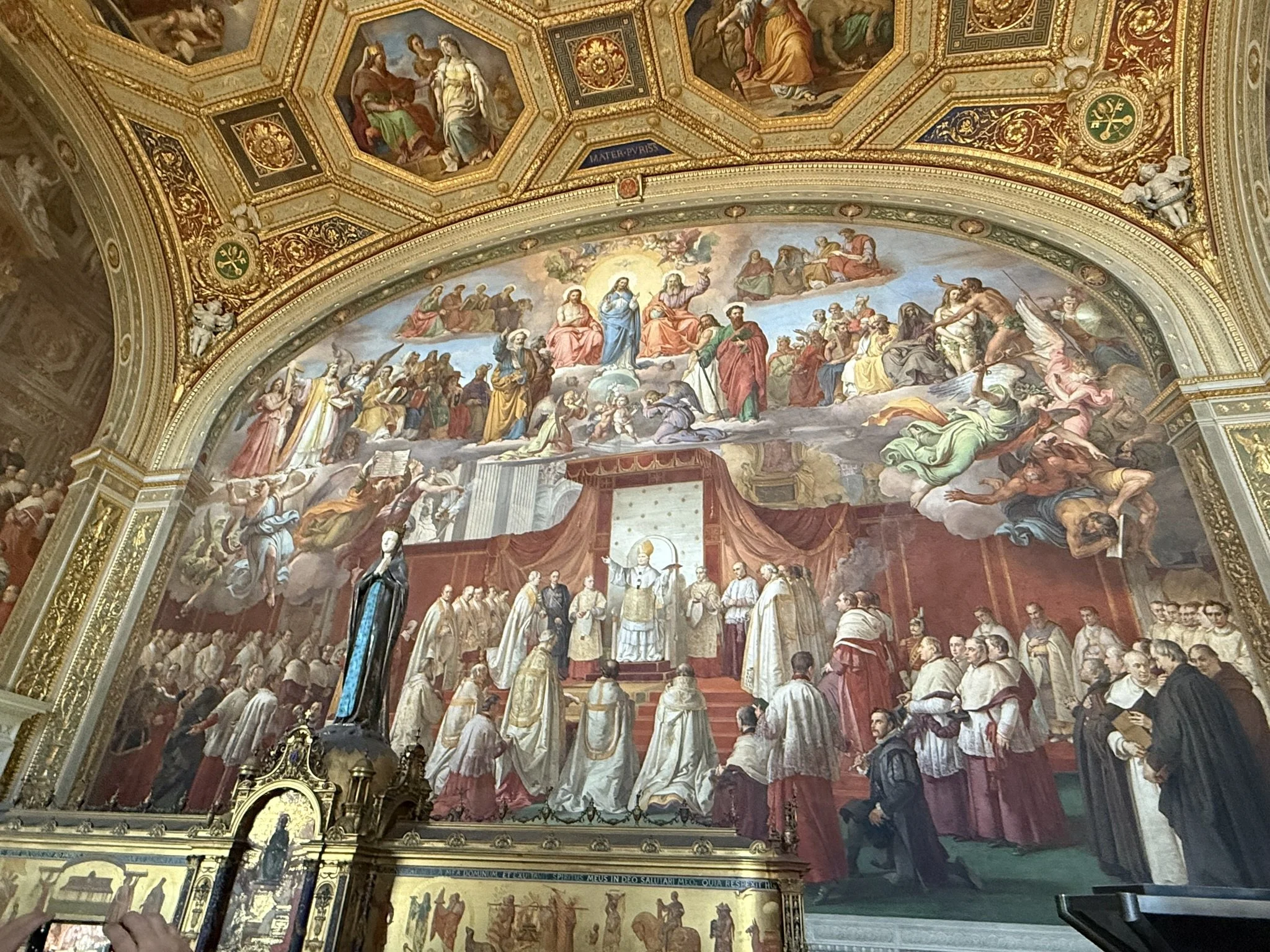
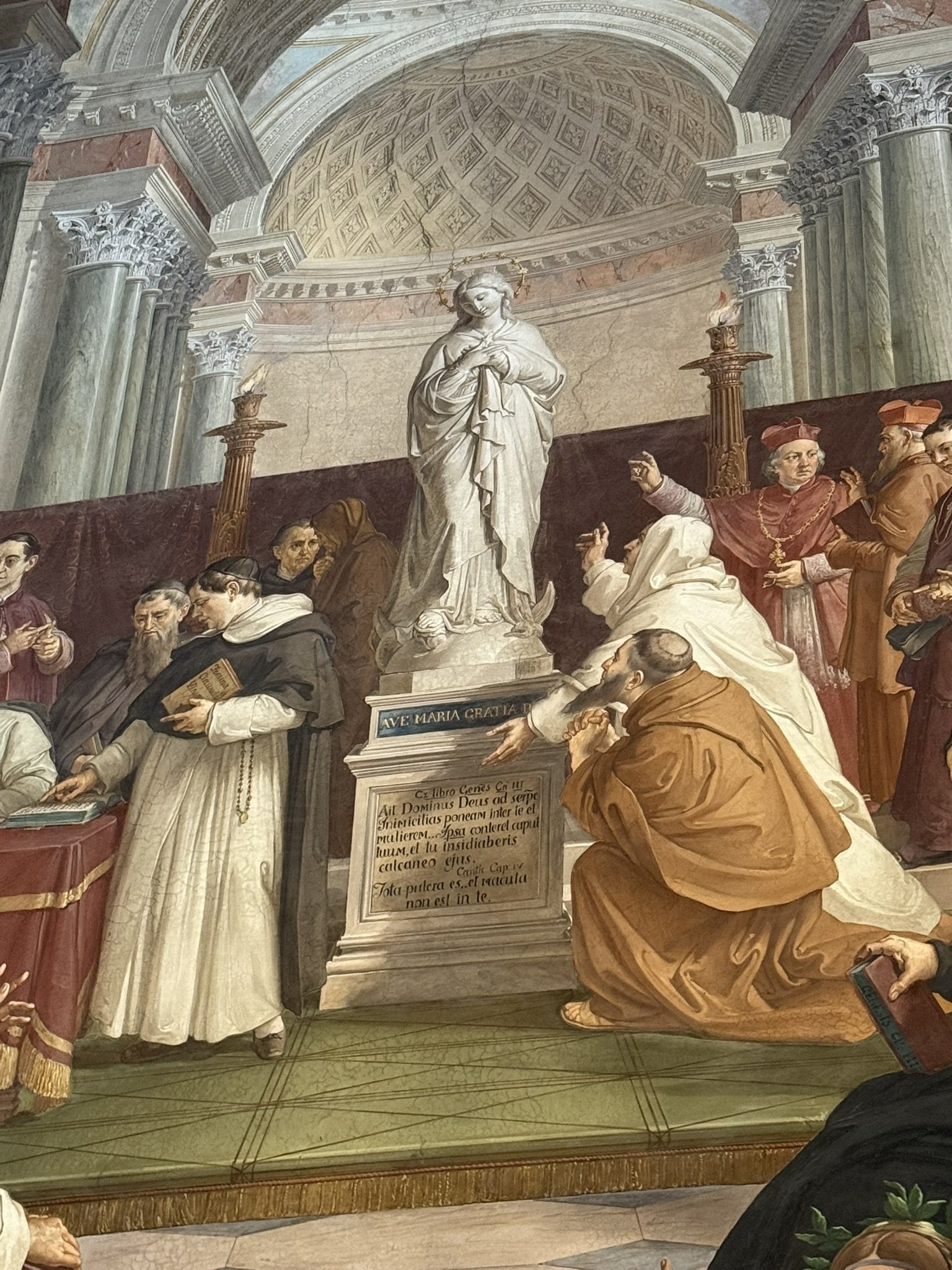
An entire room dedicated to the declaration of the dogma of the Immaculate Conception. This statue of Mary tops what is essentially a bookcase, with facsimiles of the documents relating to the dogma.
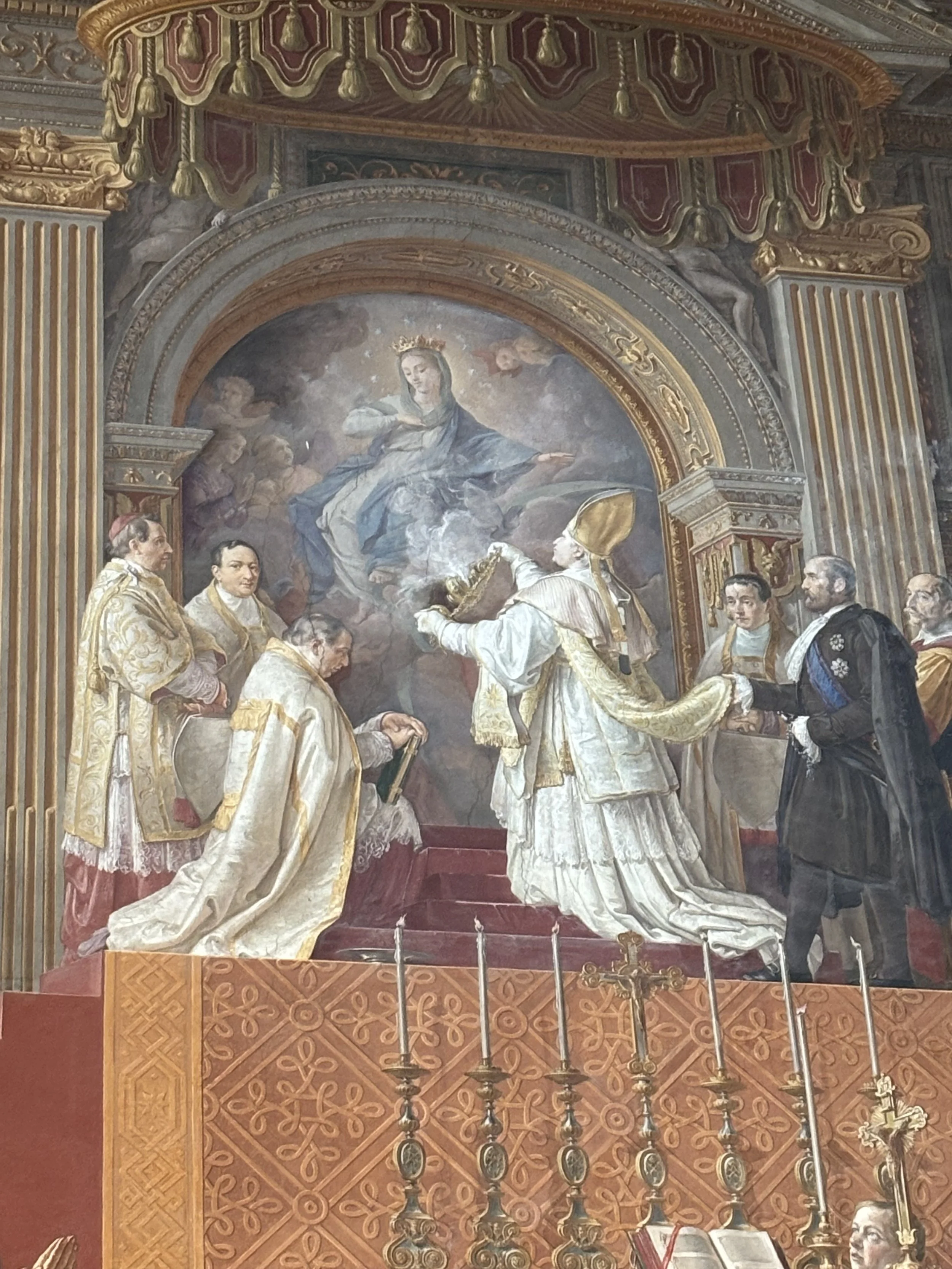
The East Wall shows the coronation of the image of Mary, following the proclamation of the dogma of the Immaculate Conception.
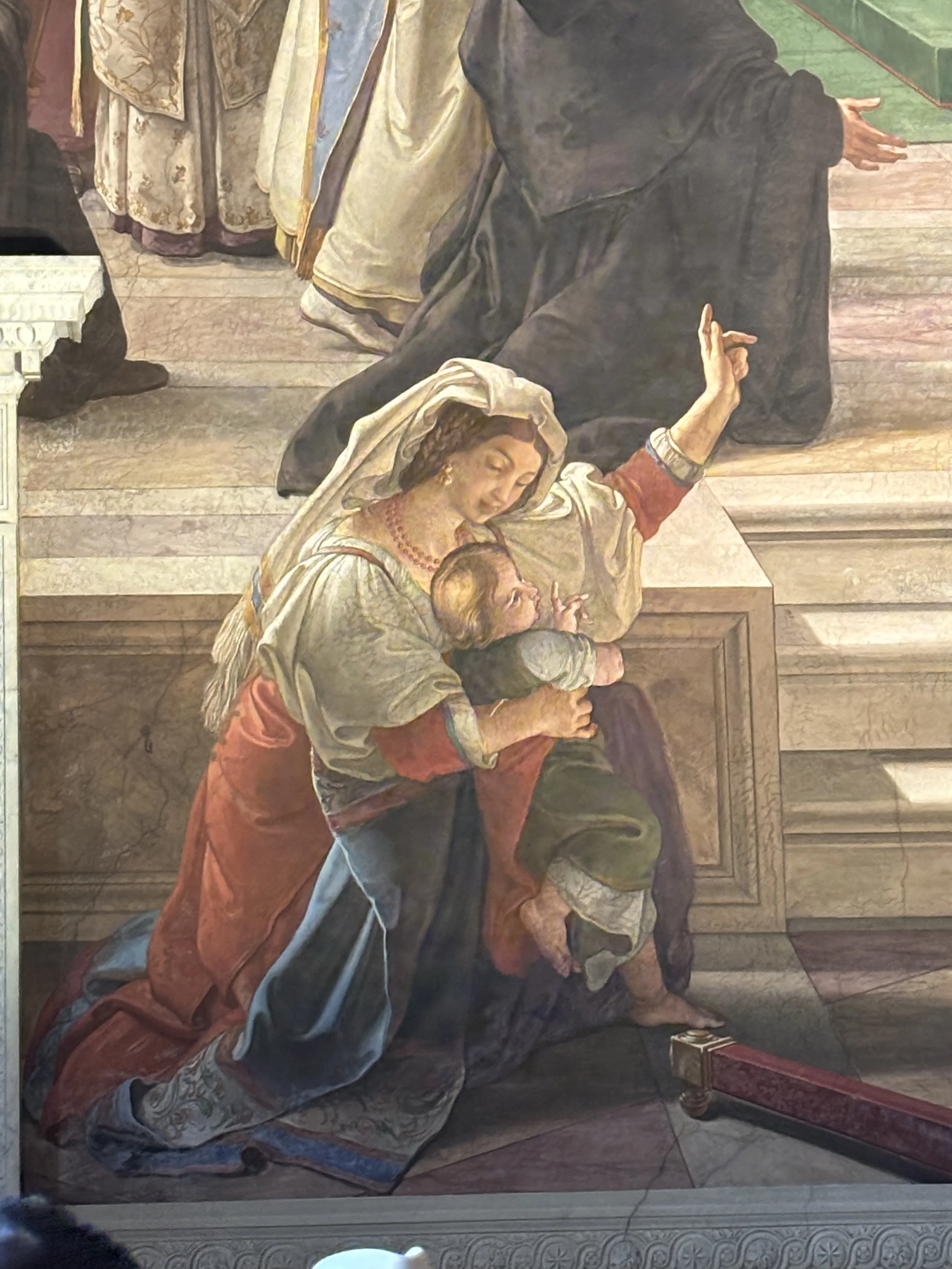
I love this picture, because so often either I or my wife will point to things, in just this way, to our children. We are also pointing towards a statue, or a painting, or the Eucharist itself. Always trying to direct their gaze towards Christ. In reality, this is what Mary does as well. All things that Mary has were gifts bestow by God. There is nothing of Mary that isn’t given her by God.
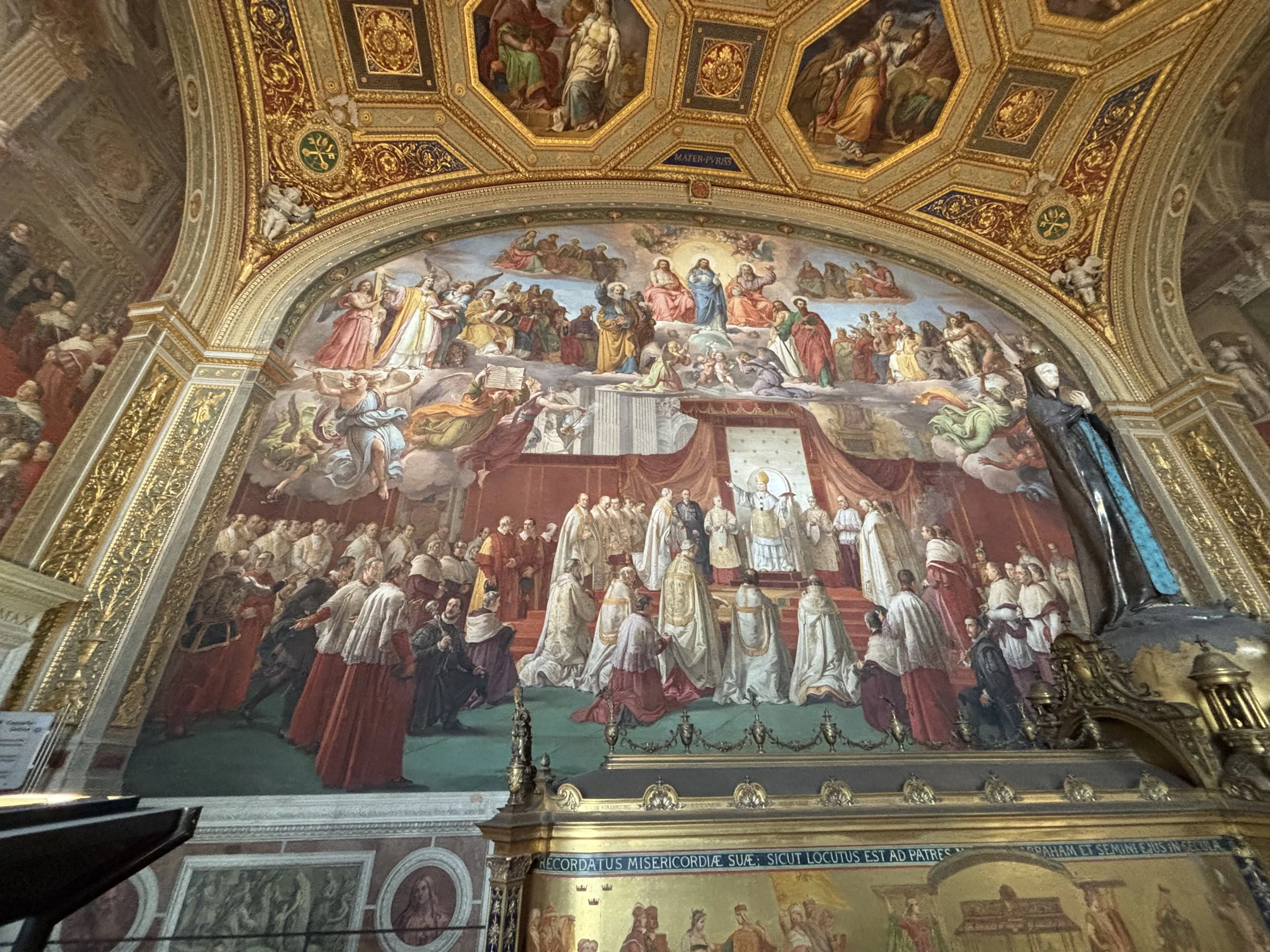
The South Wall in the Room of the Immaculate Conception depicts the actual declaration of the Immaculate Conception. It takes up the entire wall, bringing your attention to it right away.
While the lower part depicts the earthly realm, the upper wall shows the celestial one. You can see the Trinity depicted, as well as saints from the Old and New Testament.
It’s hard to tell in my photo, but Mary is actually a little lower than the Trinity, showing that God is still supreme and Mary is not their equal.
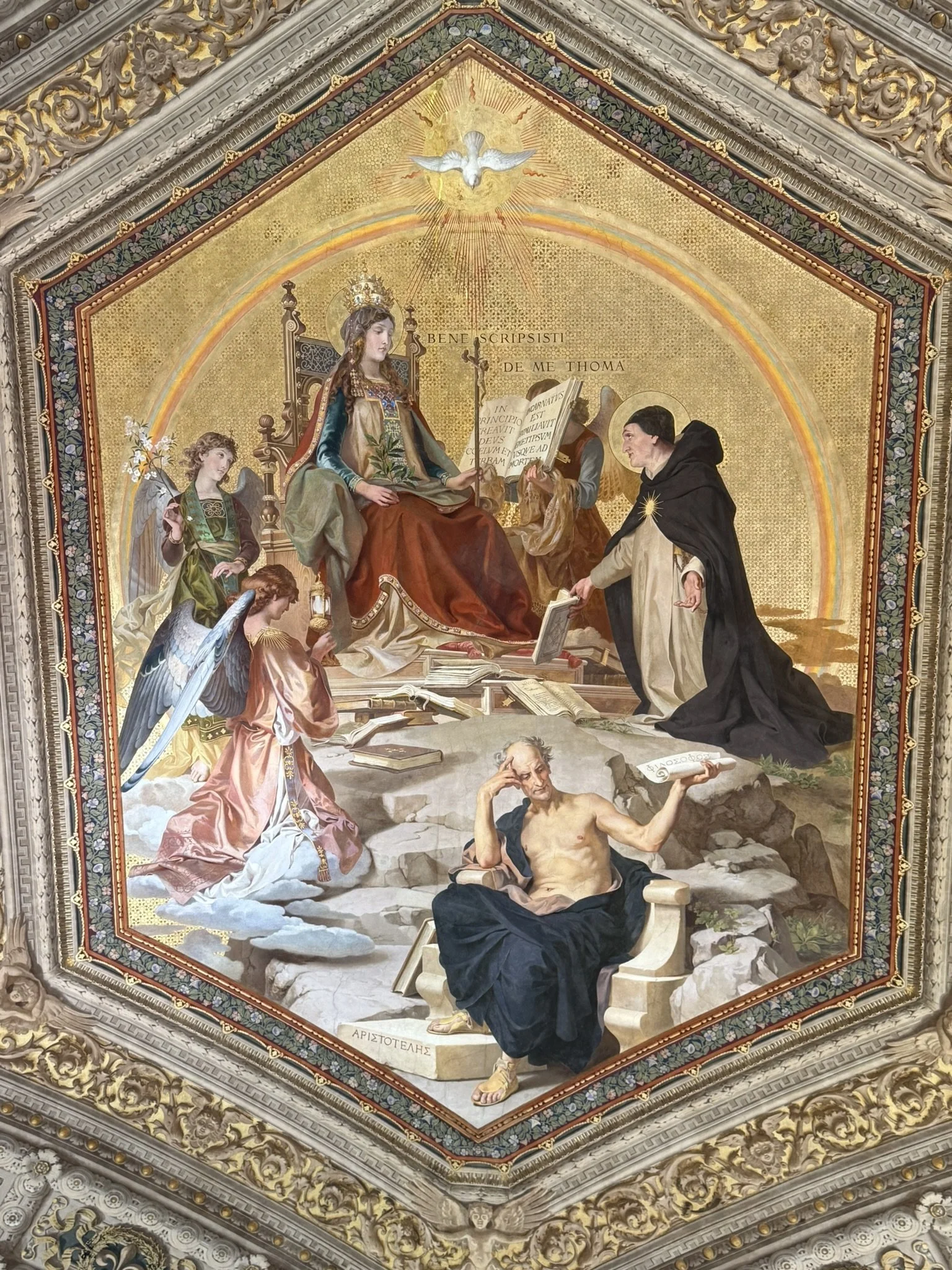
The Latin phrase you see translates to “You have written well about me, Thomas.“ The crowned woman sitting is the personification of the Church (wearing the same crown as the pope). The man sitting at the bottom is Aristotle, upon whom Thomas rested much of his philosophy.
St. Thomas Aquinas offers his works to the Church and, ultimately, to God.
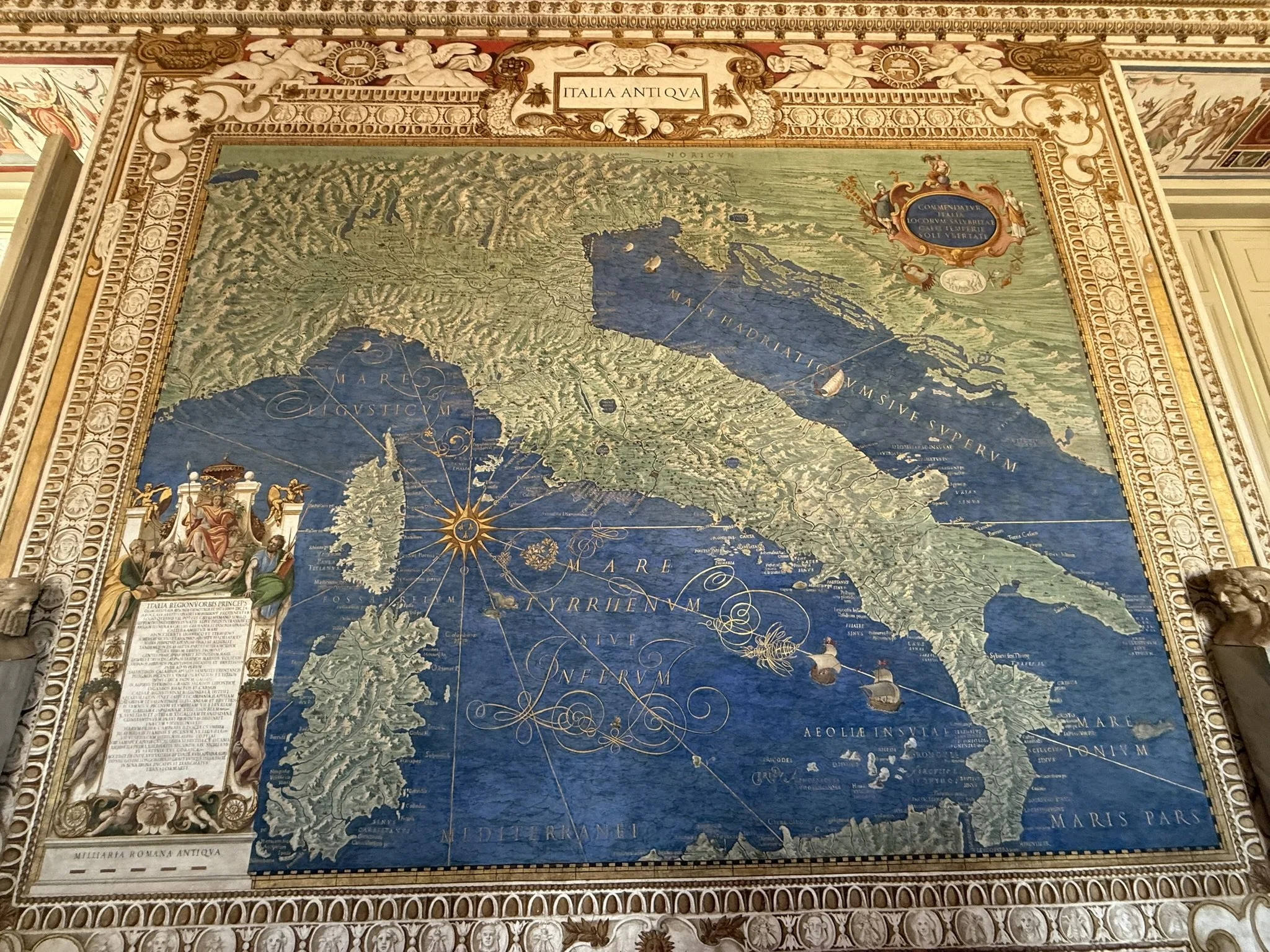
These maps are huge. What’s cool is that they are practical, with scales in the legends and everything.
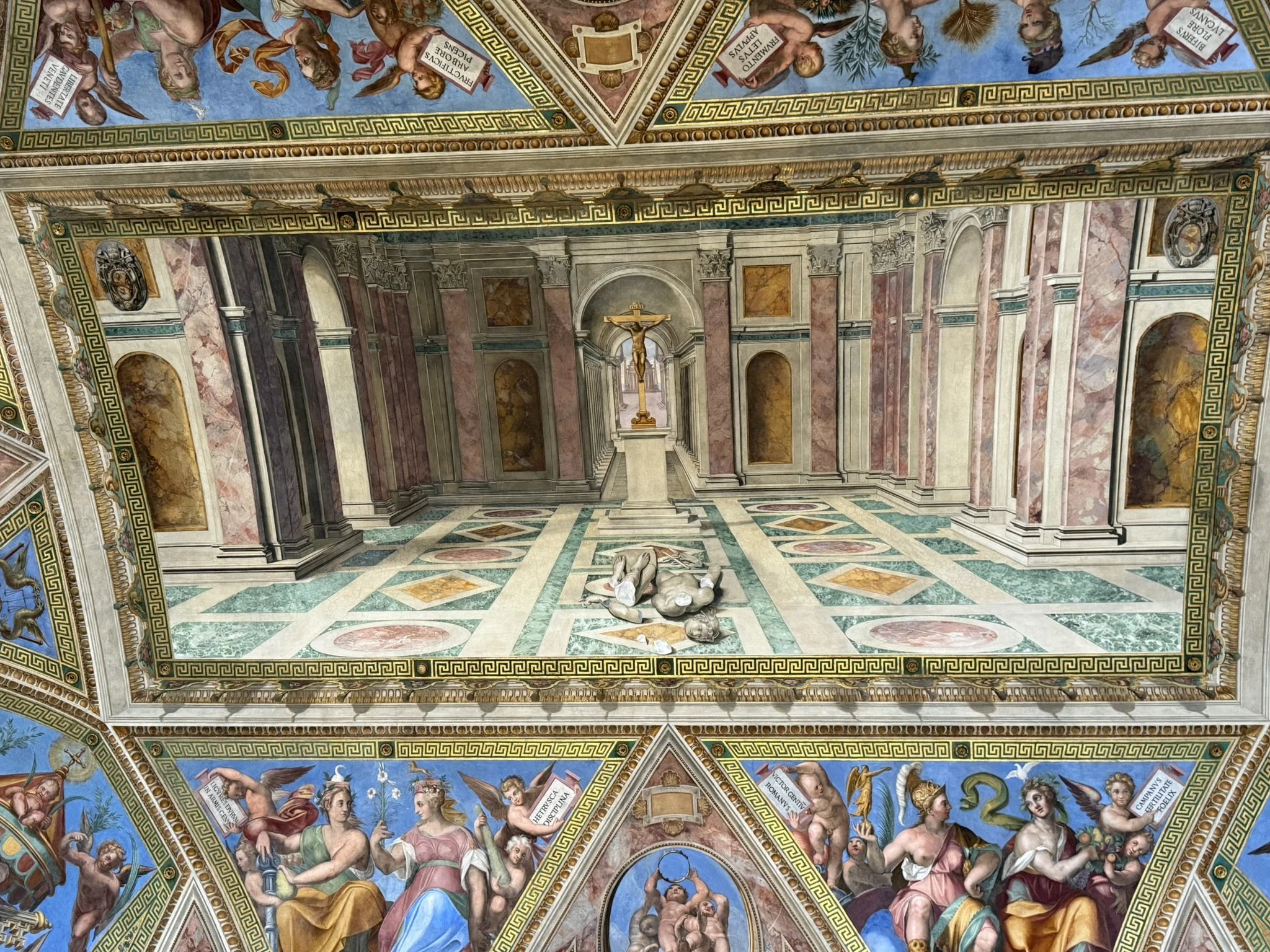
A pagan lies on the floor, broken and in ruins. Smashed. The statue is well crafted and shows strong artistry. It is also well built. In its place is a crucifix. It’s simple and small. Yet, it stands. It’s a subtle and simple piece, yet elegant and effective in its message.
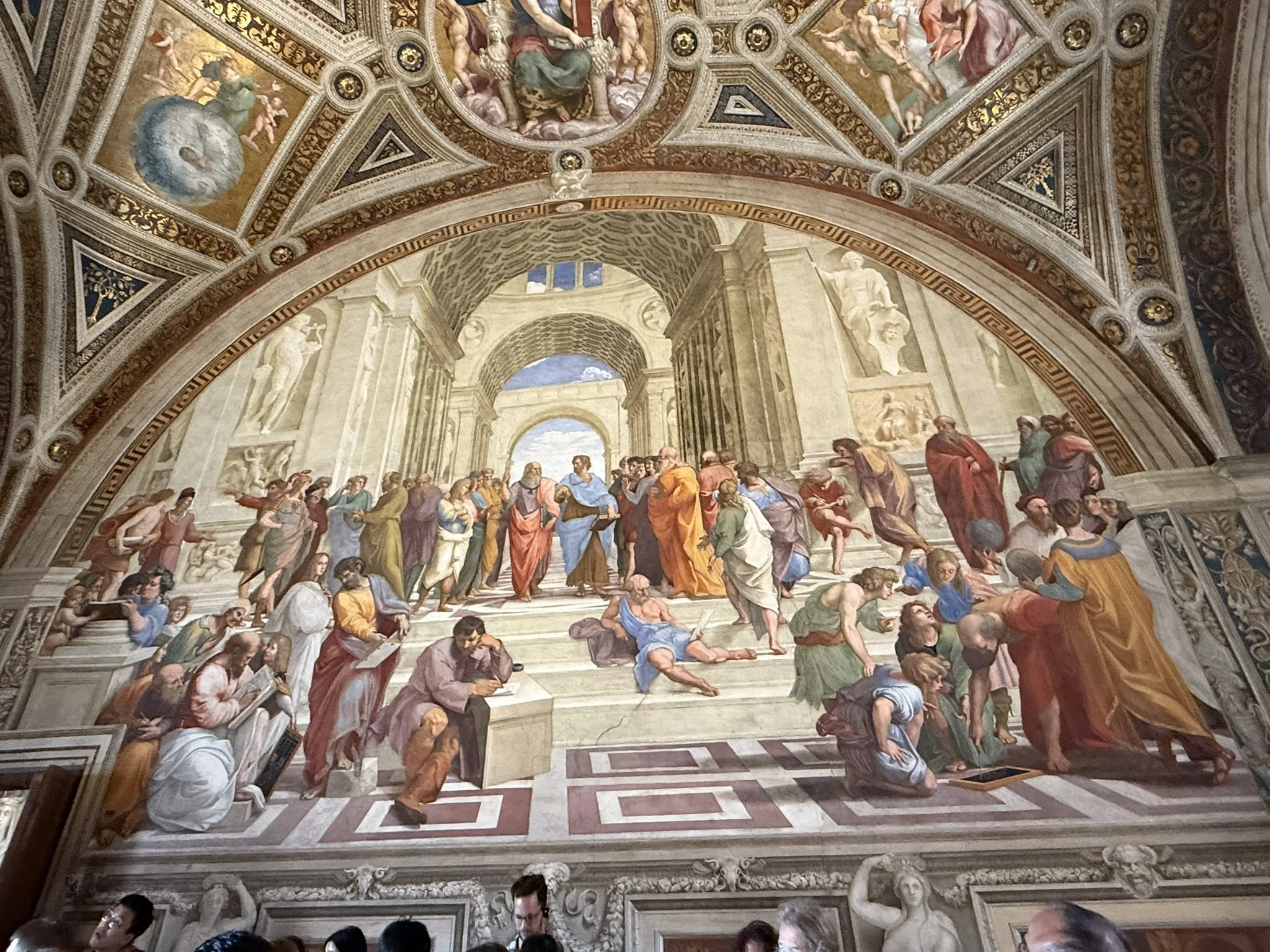
This is one of the most famous paintings in history. It depicts reason. The painting shows a gathering of great minds, such as ancient philosophers, mathematicians, scientists, and others, all in pursuit of truth through natural reason and their cognitive abilities.
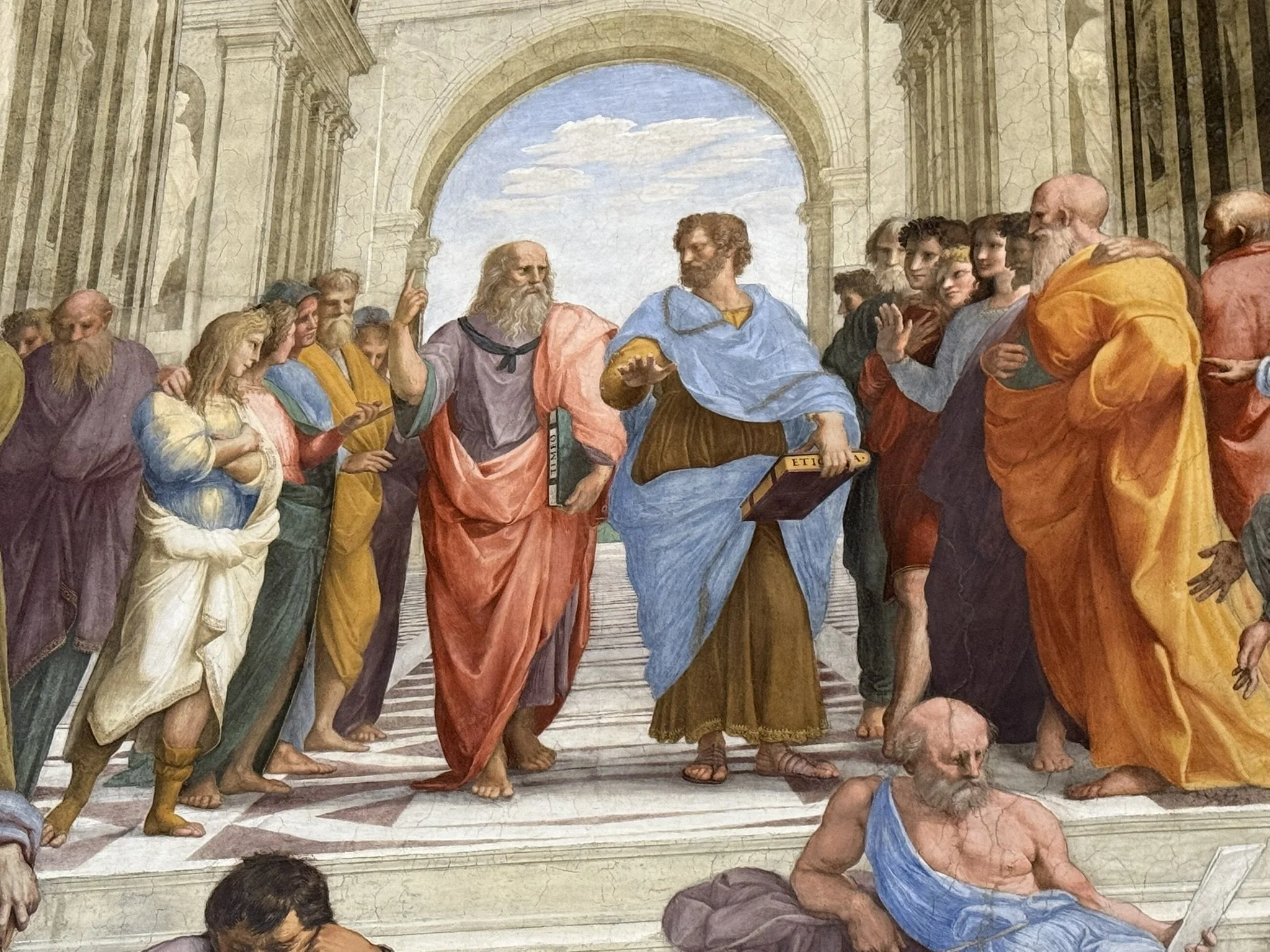
Plato in the middle points upward, showing his transcendent philosophy with eternal truths. Aristotle points horizontally towards the ground, showing his practical and “grounded“ philosophy.
It must be paired with the next set of paintings…
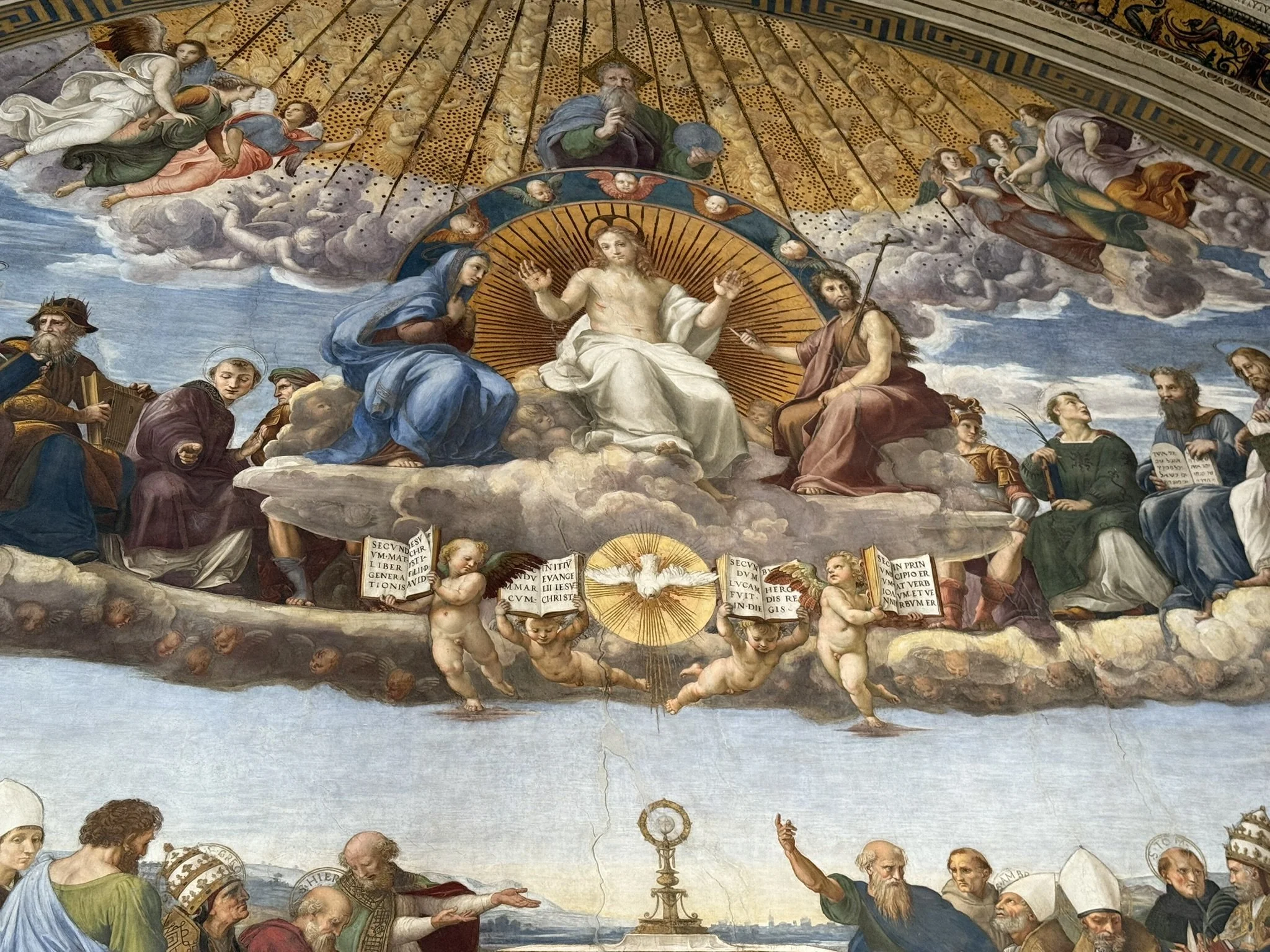
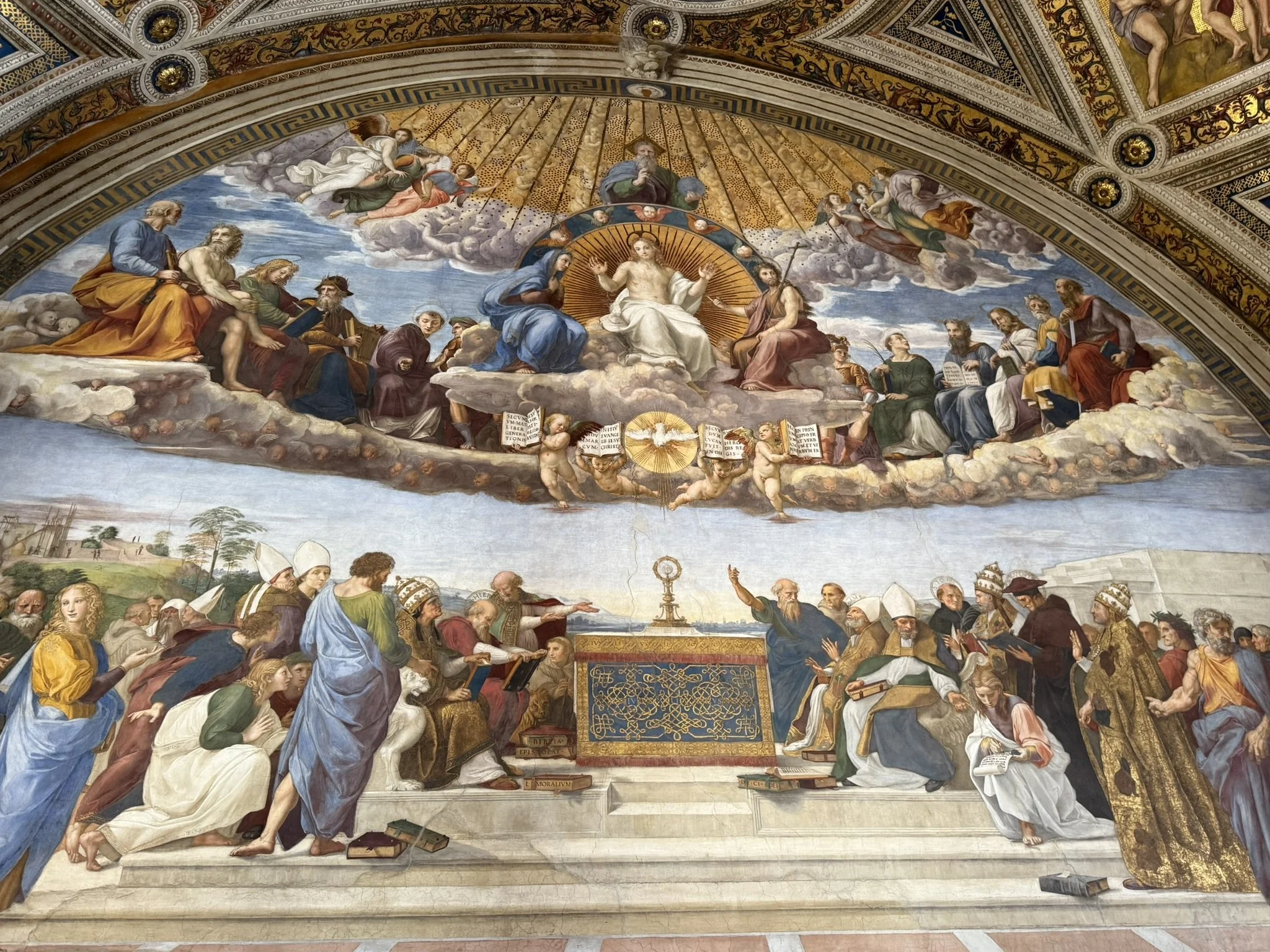
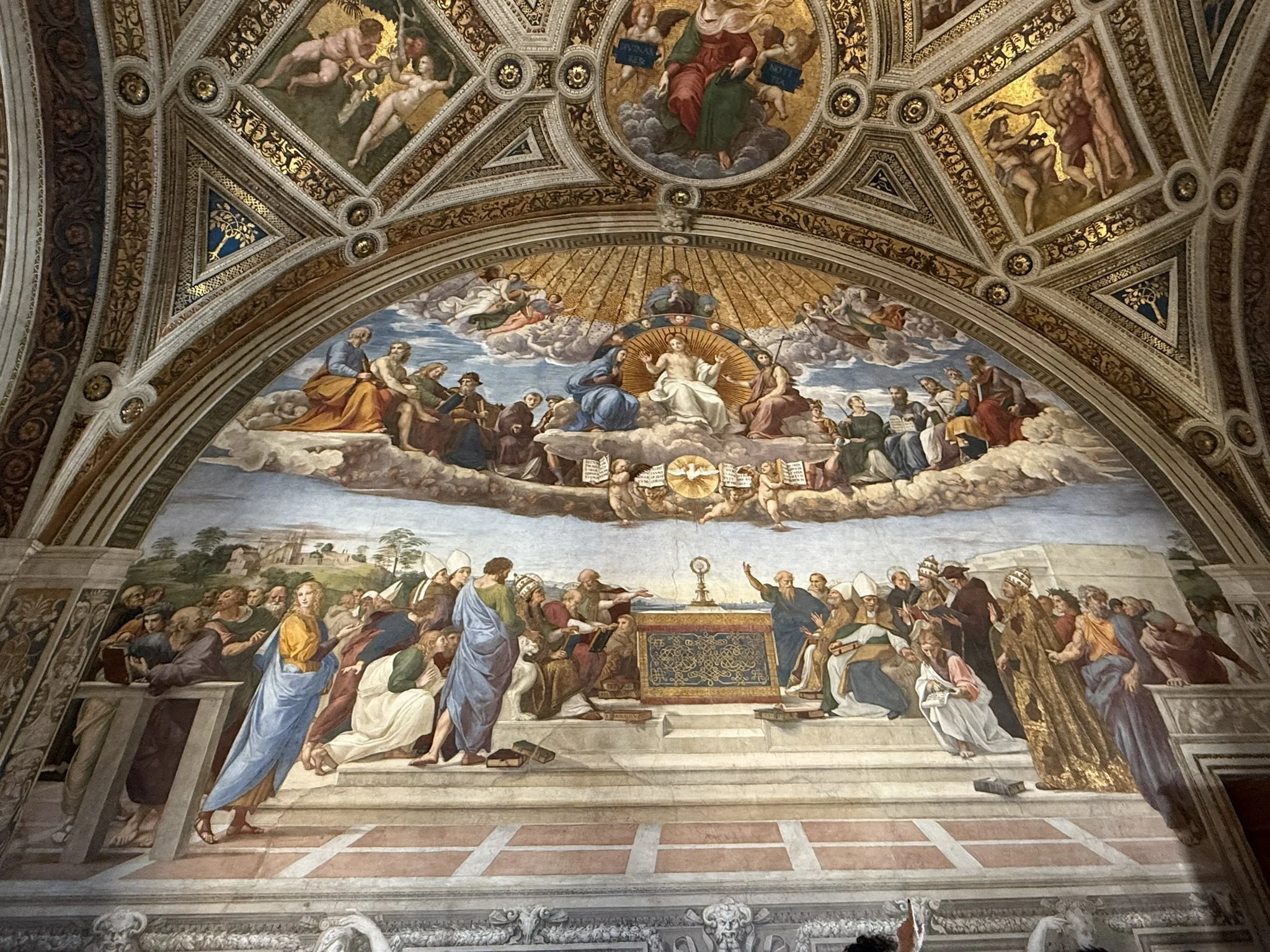
We now see faith, although more specifically revelation and theology.
Above, Jesus is enthroned in Heaven, with the Father above him and the Holy Spirit beneath. Mary is shown, along with John the Baptist, patriarchs, prophets, and New Testament saints. The earthly realm is depicted, with the focus being the Eucharist. As a result, it isn’t really earthly.
These two images show the unity of faith and reason. They aren’t opposed to each other, although they are different. That said, only revelation shows all truth, whereas the natural reasoning can only lead to so much knowledge.
West Wall of the Room of the Immaculate Conception. It depicts the ecclesiastical debate and discussion leading up to the formal proclamation of the dogma.