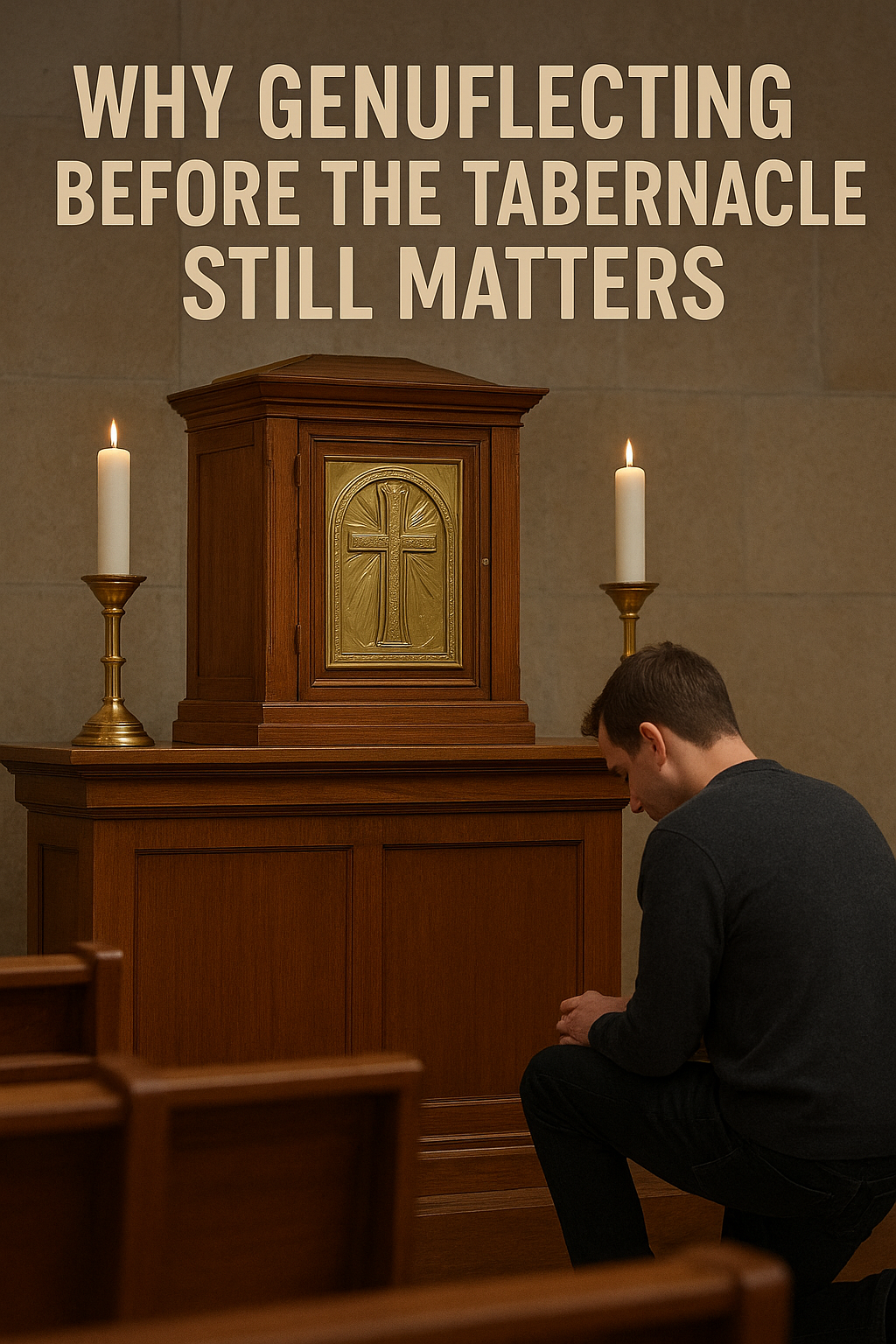
Catholicism is a faith of both word and gesture. It has always been a faith that integrates the body with the soul, the visible with the invisible, the external gesture with the internal belief. We are not disembodied spirits, but embodied persons. So, the way we worship God must involve our whole selves. In case you haven’t noticed, Catholic liturgy is filled with bodily actions: standing, sitting, kneeling, processing, striking the breast, making the Sign of the Cross. Each of these is more than ritual choreography. They are visible signs of invisible realities, enacted reminders of what we believe.
Among these gestures, one of the most familiar is genuflection: bending the right knee to the ground before entering or leaving a pew when the Blessed Sacrament is reserved in the tabernacle. For many Catholics, cradle and convert, it can become routine, thoughtless, and even mechanical: step into the pew, drop the knee, slide in. Yet, genuflection remains one of the most theologically rich, historically grounded, and spiritually formative gestures we make. In this post, we will explore why genuflecting before the tabernacle still matters - not only as a devotional habit, but as a deeply Catholic proclamation of faith, worship, and reverence. Our bodies pray alongside our minds and hearts. Yet behind this simple motion is a profound theological truth and a long history of worship that stretches back through the centuries of the Church. To genuflect is to proclaim with the body what the heart believes: Jesus Christ is truly present here in the Eucharist.
What Is Genuflection
Genuflection is when one bends a single knee to the ground, as opposed to kneeling which involves both knees. In English we get the word genuflection from the Latin genuflectio, although this term actually originally meant to kneel. The General Instruction of the Roman Missal is explicit about how to genuflect and what it signifies.
“A genuflection, made by bending the right knee to the ground, signifies adoration.” (GIRM, 274). This can be contrasted, as stated, from kneeling. It can also be contrasted with a bow, which are of “two kinds… a bow of the head and a bow of the body.“ (GIRM, 275).
Which knee is important. The left knee is technically the one you put on the ground when kneeling to a ruler, dignitary, or someone in authority. In church, the right knee is bent to the ground. The gesture shouldn’t be new. Besides church, we see it in movies and shows before royalty and when people propose to their significant other.
Now that we know what it is, the next question is where did it come from?
The Biblical and Historical Roots of Genuflection
The historical roots aren’t clear. Proskynesis - where a person would prostrate/lie completely down and kiss the ground or body parts of the other person - was very popular in the centuries before Jesus. Alexander the Great seems to have made genuflection the preferred sign of reverence in his court, which appears to have stuck around and made its way to other kingdoms as well.
The act of bending the knee has deep biblical roots. St. Paul writes to the Philippians: “at the name of Jesus every knee should bow, in heaven and on earth and under the earth.“ (Philippians 2:10). This powerful passage situates genuflection within the universal worship owed to Christ, whether angelic beings in heaven, human beings on earth, or even demonic powers under the earth. All creation is called to acknowledge His Lordship.
Other passages reinforce this idea. Some of these passages speak specifically about genuflection within the context of worship. The Psalmist tells us “Oh come, let us worship and bow down; let us kneel before the Lord, our Maker!“ (Psalm 95:6). We read about Solomon doing similarly, when in 1 Kings 8:54 we read “Now as Solomon finished offering all this prayer and plea to the Lord, he arose from before the altar of the Lord, where he had knelt with hands outstretched toward heaven.“ (2 Chronicles 6:13 is similar) We see in the Gospels, those who approached Jesus in faith often knelt before Him, such as a leper who “came to him, imploring him, and kneeling said to him, ‘If you will, you can make me clean.‘“ (Mark 1:40. See also Matthew 17:14, Matthew 20:20, Matthew 27:29, Mark 15:19). We see political and religious leaders kneeling before Jesus, such as when “a ruler came in and knelt before [Jesus], saying ‘My daughter has just died, but come and lay your hand on her, and she will live.‘“ (Matthew 9:18). The biblical instinct is clear: bending the knee is a bodily recognition of divine majesty.
In the early centuries of the Church, however, Christians did not genuflect as we do today. The posture of standing was often emphasized, especially during the Easter season, as a sign of resurrection joy. Kneeling was associated with penance. But as devotion to the Eucharist deepened—especially as the theology of the Real Presence became more explicitly articulated—kneeling and genuflection became recognized signs of adoration before Christ in the Blessed Sacrament.
By the Middle Ages, genuflection before the reserved Eucharist was common across Europe. The Fourth Lateran Council in the 13th century reaffirmed the doctrine of transubstantiation, which in turn reinforced the importance of bodily reverence before the consecrated Host. What had been implicit for centuries - faith in Christ’s sacramental presence - was now expressed explicitly and ritually. Genuflection became a standard Catholic gesture, enshrined in rubrics and reinforced by centuries of practice.
This practice is explicitly still preserved in the General Instruction of the Roman Missal, as we saw in the quote above.
Now we know what it is, and where it came from, but when do we do it?
Times and Places: When Do I Genuflect?
There are some specific times during Mass that one should genuflect. The General Instruction of the Roman Missal (GIRM for short), where the following directives are found, governs only our actions within the context of and in association with Mass. Mass is a time of worship, when we are focused solely on God and our giving the worth due to him (the Son) to him (the Father). Since this is our highest calling, every move should be scripted and carefully laid out (wouldn’t we do that for a banquet for a head of state or another important person?).
Also, I’m focusing on genuflection by the laity. If you want to know when the priest or deacon genuflects, then read the footnote below.(1)
Genuflection is “reserved for the Most Blessed Sacrament, as well as for the Holy Cross from the solemn adoration during the liturgical celebration on Good Friday until the beginning of the Easter Vigil.“ So, one genuflects to the Blessed Sacrament, whether veiled or unveiled and whether in the tabernacle or outside of it. There is an exception during Mass, if one is in procession and carrying the processional cross (which shouldn’t be showing honor to anything, since the crucifix has upon it the corpus of the one we are honoring) or candles (dangerous to kneel and stand back up with an open flame).
One also genuflects to the cross from Solemn Adoration during the Good Friday service until Easter Vigil.
Importantly, it is only during these times that one should genuflect within Mass. It might seem like a good and pious act to genuflect to a statue of Mary during a particular Marian feast. However, because genuflecting is a sign of adoration, genuflecting outside of these times risks giving confusing signs of adoration. Remember the context of what is occurring at Mass: worship of God. Using the same act of adoration for Mary as what you are using for God, within the context of worshipping God, gives at best a confusing signal.
So, we’ve got the what, the where, and the when. So let’s discuss the why.
The Theology of Genuflection: Faith Made Visible
Why do Catholics reserve such reverence for the tabernacle? The answer is simple: The Real Presence of Jesus in the Eucharist. The Catechism of the Catholic Church states “The mode of Christ’s presence under the Eucharistic species is unique… In the most blessed sacrament of the Eucharist ‘the body and blood, together with the soul and divinity, of our Lord Jesus Christ and, therefore, the whole Christ is truly, really, and substantially contained.‘“ (CCC, 1374). This is why the Church instructs that latria (adoration, honor due to God alone) is owed to the Eucharist. The Eucharist is not a symbol alone; it is Christ Himself. Genuflecting before the tabernacle, then, is not simply about respecting a piece of furniture or even honoring a sacrament in the abstract, or an action we pretend to be done in front of God. It is about worshiping the living Christ who dwells there.
This not not merely an outward spectacle. We are warned that it is not only our knee that bows but our heart as well. Thus, “The venerable practice of genuflecting before the Blessed Sacrament… requires that it be performed in a recollected way. In order that the heart may bow before God in profound reverence, the genuflection must be neither hurried nor careless.“ (Inaestimabile Donum, 26).
The gesture becomes, in effect, a wordless creed. Without speaking, the body proclaims! I believe in the Real Presence. I acknowledge that You are my Lord and my God. It is a visible catechesis, a bodily witness to what Catholics profess in the Nicene Creed: “I believe in one Lord Jesus Christ.”
This bodily witness is also countercultural. In a world where kneeling is often dismissed as weakness or subservience, the Christian act of genuflection is radically different: it is not submission to human power, but loving adoration of divine love. To bend the knee before Christ is to declare that no other power, no other ideology, no other ruler has ultimate claim on our lives. Only Christ does.
So, we’ve answered the what, where, when, and why of genuflection, but how do we genuflect in an intentional way?
Parish Practice: Reviving the Gesture with Intentionality
In most U.S. parishes, Catholics still genuflect before entering a pew. Yet many do so hastily, sometimes without even looking at the tabernacle. It’s the same we sometimes do for the Sign of the Cross: like opening a door, it is something we do before and merely in order to do something else. The motion risks becoming a muscle memory rather than a conscious act of adoration. To renew this gesture, Catholics can pair the physical action with a brief prayer. Whispering, “My Lord and my God” (echoing the words of St. Thomas in John 20:28), or “Jesus, I adore You,” transforms a routine habit into a moment of faith.
Parishes can also play a role in reviving intentionality. Catechesis on gestures (through homilies, parish bulletins, or catechism classes) helps remind the faithful why we do what we do. Even adults need a reminder and a refresher on the signs and symbols and gestures of our Faith. Just like telling your spouse “I love you“ can become a route gesture (and therefore we need to be sometimes reminded why we say “I love you“), so too do we need to be reminded that our outward actions reflect and inform our interior belief. Parents especially play a crucial role for children. Teaching children to genuflect reverently not only passes on a Catholic custom, but it instills a sense of Eucharistic reverence from an early age. A child who learns to genuflect carefully before the tabernacle often grows into an adult who approaches the Eucharist with awe.
Genuflection can also serve as a subtle form of evangelization. If you knew I was going on a date, and you saw me wear shorts and a t-shirt, not paying attention to the time, not even looking or addressing my date, would you say I was going on an important date or an unimportant date? If I said I had a meeting, and I had holes in my shirt, messy hair, and just shuffled along to the meeting, you would rightly guess that I did not think that meeting very important. Why should it be any different if I just rotely and carelessly partially bend down and throw a quick Sign of the Cross before the Blessed Sacrament? Visitors who enter a Catholic church and see people genuflecting before entering pews are given an unspoken lesson: something profoundly sacred is here. In this sense, our bodies preach before our mouths do. The way we carry ourselves in the presence of the Eucharist bears silent witness to Christ’s presence.
For Those Who Cannot Genuflect
Of course, not everyone is physically able to genuflect. Age, injury, disability, or illness can make it difficult or impossible. The Church recognizes this reality. The point is not the exact mechanics, but the reverence expressed, which from that reverence comes the physical act. It is not that the physical is unimportant. Rather, it is not the sole import.
A reverent bow of the head or body, made slowly and prayerfully, can convey almost as much meaning as kneeling. The interior disposition of adoration is vitally important. In fact, for someone who cannot bend the knee, the deliberate choice to make a deep bow can be an even more powerful witness of intentional reverence. Bodily gestures in worship are not external actions for their own sake, but are meant to be combined with an interior attitude. Man is both spirit and body, both internal and external. Our actions in liturgy should reflect this reality. So, if you are unable to genuflect, as long as your interior attitude is one of adoration, than all that is expected of you is that your exterior reality tries its best.
Why It Still Matters Today
In an age when reverence is often countercultural, genuflection stands as a quiet yet radical act. Recently, So much of media and society is about irreverence, deconstruction, and trying to bring things low to our level. We live in an era where reverence is in short supply. Our society prizes casualness, informality, and speed. In reality, it is about trying to make oneself feel better, not by trying to be better but by tearing down to ones lower level anything that stands above. Genuflection stands as a simple, silent, yet powerful counteraction. Sacred spaces risk being treated as multipurpose rooms rather than holy ground. But genuflection reminds us that churches are not mere halls of fellowship, but rather they are sacred spaces where Christ dwells. As important as fellowship is, the liturgy is first and foremost an encounter with God. Genuflection, then, trains us to place God at the center. It grounds the liturgy in worship rather than in mere social interaction. It offers a public yet personal testimony: I believe Jesus is here.
As parishes continue to emphasize Eucharistic revival in the United States, rediscovering the depth of our gestures is crucial. Genuflecting before the tabernacle is a simple and humble act that renews our Eucharistic faith. Whether by bending the knee or bowing the body, we declare not just with words but with our whole selves that this is the house of the Lord, and Christ dwells herein.
In such a context, genuflection becomes countercultural: a deliberate pause, a physical act of humility, a recognition that this space is different because Christ is here.
(1) The priest genuflects three times during Mass: “after the elevation of the host, after the elevation of the chalice, and before Communion.” Also, priests, deacons, and other ministers genuflect when they approach or depart the altar - in other words, immediately before and after Mass. This does not apply during Mass, such as when a Reader or Extraordinary Minister of Holy Communion approaches the altar or enters the sanctuary (and was one of the hardest habits I had to break when I became a Reader).
