In my time teaching Catholics, I have encountered a wide range of questions about our Faith. They really run the gamut of topics, fields, and subjects. However, there are some questions that come up again and again among the Catholics I teach and speak with. These questions reveal some serious misconceptions about the Catholic Faith; not only about what the Church teaches but also why it teaches certain things. Whether cradle Catholic or convert does not seem to change it.
These aren’t hard-hitting misconceptions, and no one should feel bad for having them. There are plenty of reasons someone might have these ideas. The Catholics I was speaking with were all good and faithful Catholics, knowledgeable about their Faith and in love with Jesus. But it’s important to confront these misconceptions and move on.
1) It’s Important, but not Necessary, to Go to Mass
Objection: The only thing that matters are things like what we believe, or that we treat our neighbor nicely. Things like going to Mass aren’t important.
This misunderstands what Mass actually is. If we fully understood the gravity and grace of what occurs at Mass, then we’d actually err towards the opposite view: one of the most important things we can do is attend Mass.
The misunderstanding - which is common for Christians, both Catholic and Protestant - is what worship is. We discussed it more at length in the post Embrace Your Priesthood, so you can go there to read more. In brief: worship is giving something its worth. There are lesser forms of worship, where we give something to another that is less that their worth. Sometimes, through the Passion of Christ, what we offer to God is elevated to something that equals what God is due (one reason why reception of the Eucharist is a requirement for a plenary indulgence). True and perfect worship is only possible at Mass, where we offer to the Father the only thing that is of equal worth: God himself in the Son.
The opposite of worship is, in a sense, Mortal Sin. Mortal Sin is the complete turning away from God. It is the definition of “turning away“ from God to say “instead of worshipping God, I am going to spend time doing X [sports, sleep, fun, etc.].“ As opposed to offering God what is due to him, we turn from him and do something else that we want to do. That is why missing Mass is a mortal sin: we prioritize something above offering to God is due worth, placing something above God. This is idol worship. This is also the reason that why you miss Mass is important. If it is out of your control, then you have not placed priority of something over God. If it is within your control, then you’ve decided to place something above the worth of God.
There is also the fact that Jesus gave the power of binding and loosing to St. Peter. (cf. Matthew 18:18). Those who reject the precept to attend Mass on Sundays and all Holy Days of Obligation are rejecting the binding requirement from the successor of St. Peter. Inherently, those who reject the authority of St. Peter in this regards rejects the Christ who gave him that authority. After all, “the one who rejects you rejects me, and the one who rejects me rejects him who sent me.“ (Luke 10:16).
2) The Catholic Church is only the Latin Church
Objection The Catholic Church is that thing I see on T.V., with unmarried priests, a bunch of Latin, and Rosary-carrying members.
This is, probably, the most common misconception about the Catholic Church. When people think of the Catholic Church, they think of Mass, Latin, unmarried priests, Rosaries, etc. This is true for Catholics, Protestants, and Orthodox. However, it is a fundamental misunderstanding of the breadth and depth of the Church. In reality, the Catholic Church - as a universal Church - is much more than just what we experience in the West. These things are only part of the Church as a whole. People often forget the large number of Eastern Rite Catholics.
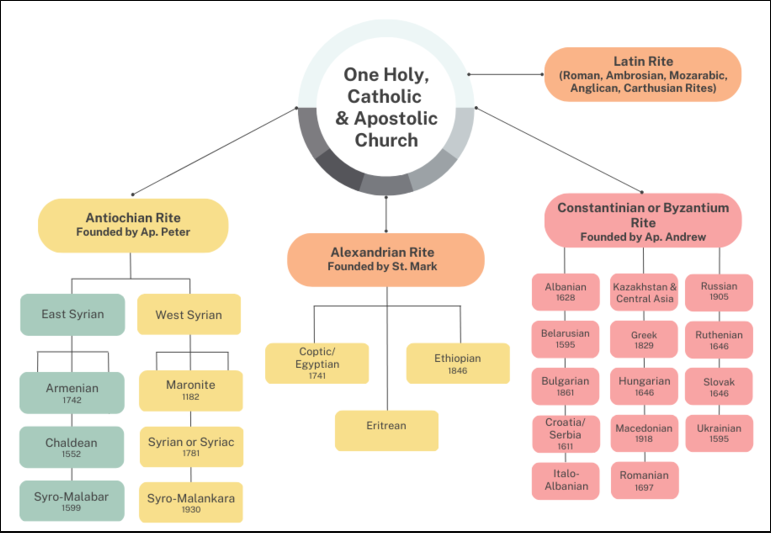
So, what is the reality? Well, within the Catholic Church are various churches. Remember in the New Testament when someone would write “To the Church in Ephesus“ or “To the Church in Rome“? These geographic areas developed unique traditions, liturgies, law, spiritual customs, and theological frameworks as they grew. Because of the difficulties associated with communication, these things would sometimes be vastly different from others. While there was still a singular Eucharist, holy orders, etc., the manner of celebrating them, the manner of thinking, and the manner of being Catholic varied.
The Catholic Church is made up of 24 sui iuris (autonomous, of one’s own right) churches. These are sometimes called particular churches. It is the same concept in the Eastern Orthodox Churches (Russian Orthodox Church, Greek Orthodox Church, etc.). The difference is that these 24 particular churches are all in full communion with Rome. They are not less Catholic than the Spaniard who goes to Mass on Sunday. They are the exact same status, in full communion with all other Catholics.
These other particular churches have their own traditions, rites, liturgies, customs, and laws. Most of them would be mistaken for Eastern Orthodox Christians, sometimes because they were Eastern Orthodox before they came back into full communion with St. Peter (one exception is the Maronite Church, which often proudly points out that they never broke from Rome). Thus, there are married priests in the Catholic Church. There are Divine Liturgies in the Catholic Church. The Catholic Church does not exist merely in the West, but rather exists throughout the world as a true, universal Church. So when we say things like “every Catholic hears the same readings throughout the entire world,“ or “the Catholic Church does not have married priests,“ we need to realize that we’re not strictly correct.
Just for reference, the other particular churches are: Latin, Maronite, Chaldean, Syro-Malabar, Ukrainian, Belarusian, Greek Church of Croatia and Serbia, Albanian, Ruthenian, Slovak, Romanian, Melkite, Coptic, Armenian, Syriac, Italo-Albanian, Ethiopian, Bulgarian, Russian, Byzantine, Hungarian, Syro-Malankara, Macedonian, Eritrean (the newest from 2015).
Again, it’s not unfair for people to have this misconception. Of the 1.3 billion Catholics, only ~18 million are Eastern Rite Catholics (that’s only about 1.3%, for those playing at home). People are simply not exposed to this idea, and they have no real reason to be. In addition, when they do encounter an Eastern Rite Catholic, they often mistake them for Eastern Orthodox.
3) Confession is only for Mortal Sins
Objection: Someone should only go to Confession when they have committed a mortal sin. So I have no reason to go right now, and someone with only venial sins wastes the priest’s time.
While we can - and should - turn directly to God immediately after we sin, Jesus also specifically instituted the mechanism whereby he wished to ordinarily forgive sins: Confession. Towards the end of John’s Gospel, Jesus “breathed on [the disciples] and said to them, ‘Receive the Holy Spirit. If you forgive the sins of any, they are forgiven them; if you withhold forgiveness from any, it is withheld.‘“ St. James also exhorts us to “confess your sins to one another.“ (John 20:22-23 and James 5:16a).
Confession provides us - sensible creatures, as in we have senses that inform our knowledge - with a sacrament so that God’s forgiveness can be communicated through the ministry of the Church. In the sacrament of Confession, we hear the actual words of forgiveness from Christ. This is something that private prayer does not provide.
In addition, we need to reconcile our relationship to God. All sin injures our relationship to God. Mortal sins involve a complete turning away from him, whereas venial sins do not involve a complete rejection of God and his love. Even though venial sins do not completely break my union with God, that does not mean they’re okay. If I’m mean to my wife, I haven’t completely destroyed our marriage, yet that doesn’t mean I don’t need to apologize! Confession gives us the opportunity to face those venial sins and make an act of apology.
Another reason Confession is fine for venial sins is that it’s a humbling experience. If you’re only confessing mortal sins, you are missing the smaller things in life that you could be doing to strengthen your relationship with God. Once we get past the “big sins,“ we start to see how much of a sinner we really are! Image you have a car that has serious engine problems. That’s clearly your main focus and goal: get the engine fixed! Once that’s taken care of, you’ll start to then look at the other, smaller parts of the vehicle. Maybe you see that the tires need inflating, or the car needs a good wash, or the oil should be changed. It’s only once you get the major issues resolved that you still see how bad your vehicle is, and all of the additional work you still need to put in.
Regular Confession is a powerful way to grow in holiness, which means going beyond merely abstaining from mortal sins. It is, therefore, not just a remedy for mortal sin but for all sin.
What misconceptions do you think are prevalent about the Catholic Church? Put them in the comments below. As always, please be charitable. We all have misconceptions and misunderstandings.
