I Can’t Understand It
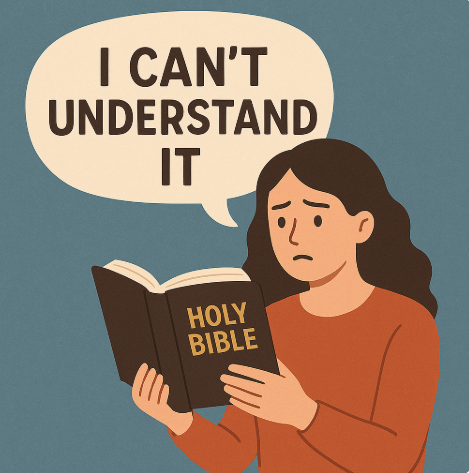
I recently had a student share with me the frustration she and her boyfriend were feeling when trying to read the Bible. “It’s hard to understand,” she said. “It doesn’t always make sense, and sometimes it feels dry.” That’s not an uncommon struggle - and it’s one of the main reasons many Christians don’t read Scripture regularly. It can be confusing, it rarely provokes intense emotion at first glance, and it’s written in a literary form that feels foreign to modern readers.
But here’s the truth: those struggles don’t mean you’re doing it wrong. In fact, they’re often the starting point of real growth. God’s Word is infinitely rich, but it takes time, patience, and the right approach to experience its depth. When we learn to engage Scripture properly, what once felt difficult begins to transform into a dialogue with the living God.
Below are some reflections and practical suggestions that I gave to that student—and that I believe can help anyone who desires to make Scripture a more fruitful part of daily life. These insights are grounded in Catholic tradition, informed by biblical scholarship, and oriented toward a deeper encounter with Jesus Christ.
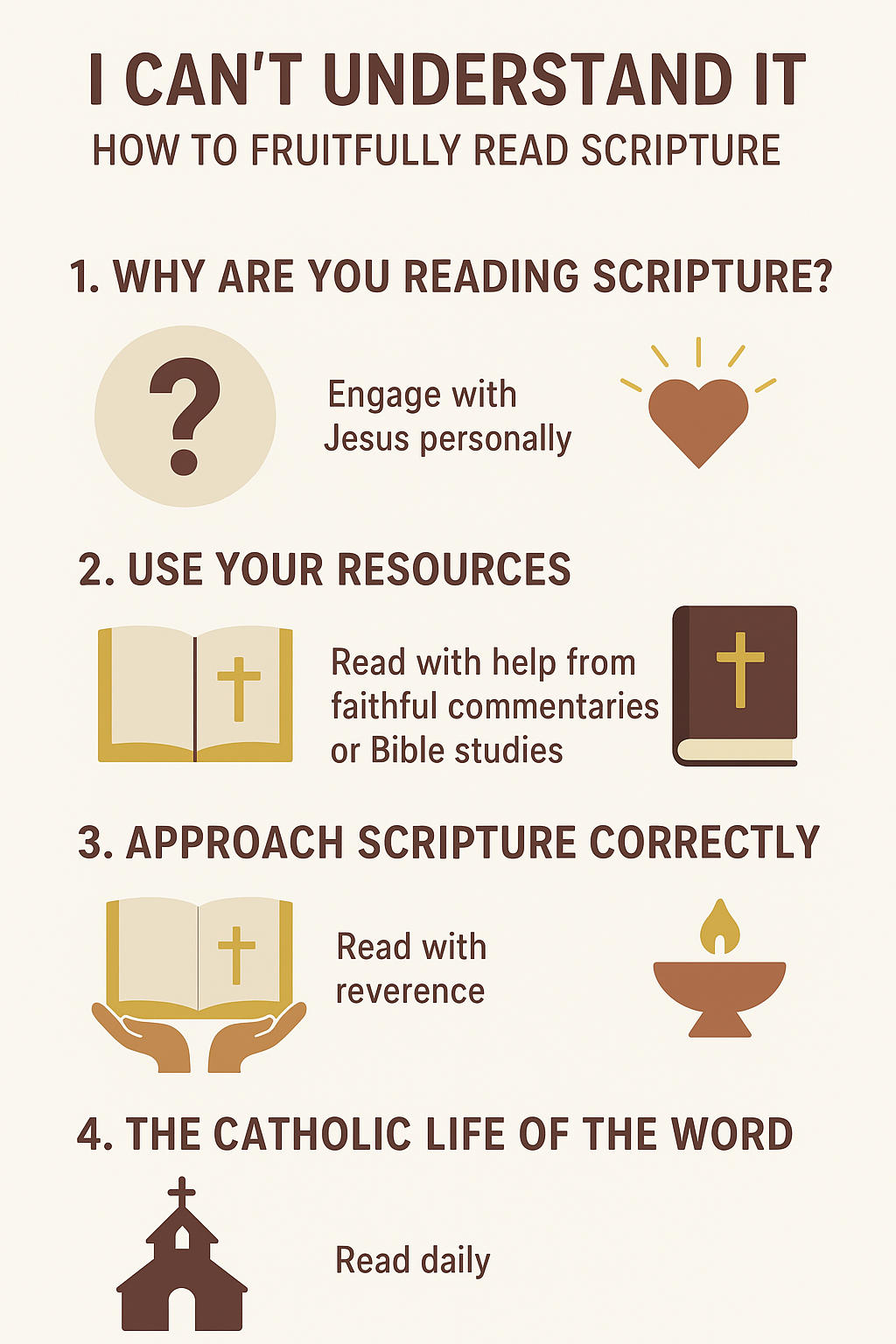
Why are You Reading Scripture?
Before opening the Bible, ask yourself a simple question: Why am I reading this?
Your answer will shape the entire experience. Are you studying for a theology course? Trying to better understand Church teaching? Hoping to grow in your relationship with God?
For most Christians, the ultimate goal should be to meet Jesus personally. That might sound strange. How can words on a page bring us into relationship with a person? But think of it this way: when you read a love letter from your spouse or close friend, those words carry the heart of the person who wrote them. They become a bridge of communion. The Bible functions in the same way. Though written by human authors, it is ultimately God’s love letter to humanity, meant to draw us closer to Him through His Son.
When I read the letters my wife and I exchanged years ago, I don’t analyze them as academic artifacts. Instead, I receive them as something living, personal, and full of love. The Scriptures are meant to be read with the same spirit. The inspired authors wrote under the guidance of the Holy Spirit so that we might encounter the living Word, Jesus Christ, in every page.
This personal encounter does not oppose academic study; it fulfills it. Understanding the text historically and theologically helps us appreciate how the Word became flesh in real time and space. As Pope Benedict XVI argued in his Jesus of Nazareth series, all serious study of the Bible should ultimately serve the goal of knowing Jesus personally and recognizing Him as the center of salvation history.
Use Your Resources
Reading the Bible can feel intimidating, but you are not meant to do it alone. As the saying goes: “It’s too dangerous to go alone - take this!”
The Catholic faith offers a treasure trove of resources to help you unlock Scripture. If you’re studying academically, use faithful commentaries such as the Catholic Commentary on Sacred Scripture (a favorite of mine) or the Ignatius Catholic Study Bible. These combine rigorous scholarship with an obvious commitment to Church teaching in a clear, faithful way. If your goal is to meet Jesus, these tools can still help by allowing you to better understand the deeper background of the text. For spiritual reading, consider the Navarre Bible series or the Didache Bible, both of which include reflections from saints, popes, and theologians. These commentaries remind us that Scripture was never meant to remain on the page. It is meant to change hearts.
Don’t overlook community, either. Written text isn’t the only resource available. Scripture was born in the heart of the Church, not in isolation. For busy people like my student and her boyfriend, joining a Bible study group can make a big difference. In the Acts of the Apostles, an Ethiopian eunuch was reading Scripture when he was approached by Phillip. When Philip asked “Do you understand what you are reading?” the man replied, “how can I, unless someone guides me?” (Acts 8:30-31). Philip explained how the text pointed to Jesus, and in doing so he brought him to faith.
The same dynamic continues today. A parish Bible study, a small faith-sharing group, or even a trusted online community can help Scripture come alive. The Word of God is meant to be heard, discussed, and prayed together. Through the Church, we receive not only understanding, but also encouragement and accountability to persevere. You can still read the Bible on your own - and please do! - but having others to talk and walk with you is a big help.
Approach Scripture Correctly
Finally, approach the Bible for what it truly is: the inspired Word of God. It is not a self-help manual or a textbook. It is not even just a collection of moral lessons or historical accounts. It is the living Word through which God continues to speak to His people.
Scripture is a divine/human collaboration - written by real people, in real times and cultures, yet fully inspired by the Holy Spirit. Every verse carries both human context and divine truth. To read it well, we must engage both the intellect and the heart. Study is important, but so is reverence.
The Bible was never meant to be a purely private book. In the early Church, it was primarily heard: read aloud at Mass or during communal prayer. That’s still true today. When we listen to the readings at Mass, we participate in the same sacred rhythm as the early Christians, hearing the voice of God proclaimed to His people.
So, when you open your Bible at home, try to do so prayerfully. Begin with a short invocation: “Come, Holy Spirit.” Read slowly. Pause when a phrase strikes you. Reflect on what God might be saying to you personally. Don’t rush to finish a chapter. Instead, linger where the Spirit invites you to stay.
Above all, approach Scripture as a gift. Treat it as you would a cherished letter from someone you love. Handle it with care, read it often, and let it shape your heart.
The Catholic Life of the Word
If we want Jesus to fill our lives, Scripture cannot remain a side project - it must become a daily encounter. The Church understands this deeply, which is why every Mass centers on the proclamation of the Word before the celebration of the Eucharist. Both are encounters with Christ - one through the ear, the other through the body.
Priests, religious, and many laypeople sanctify their day through the Liturgy of the Hours, praying with Scripture at morning, midday, and evening. This rhythm of prayer forms the heartbeat of Catholic life. It reminds us that the Bible is not only to be studied but to be lived - to inform how we think, act, and love.
If reading the Bible feels difficult, start small. Open to a Psalm and pray it aloud. Read a single Gospel story each morning. Use a reading plan, or follow the daily Mass readings. The goal is not to conquer the Bible but to let the Bible conquer you, to let its words reshape your heart and mind in Christ.
Ultimately, for the Catholic
Ultimately, Scripture is not just something we read. It is something that reads us. It reveals our hearts, exposes our wounds, and invites us to healing. The Holy Spirit uses the Word to speak directly into the real circumstances of our lives: our fears, our relationships, our doubts, and our hopes.
When you read Scripture, you are not merely studying an ancient text; you are encountering the eternal God who continues to speak. Each verse is an open invitation to communion. Every page whispers the same truth: you are loved, you are called, and you are being drawn into the mystery of Christ Himself.
So don’t wait for perfect understanding. Don’t wait until you “feel ready.” Open your Bible today. Begin with one passage. Let the Word of God meet you where you are. Trust that, in time, it will transform your heart, renew your mind, and illuminate your path.
“Your word is a lamp to my feet and a light to my path.” (Psalm 119:105).
