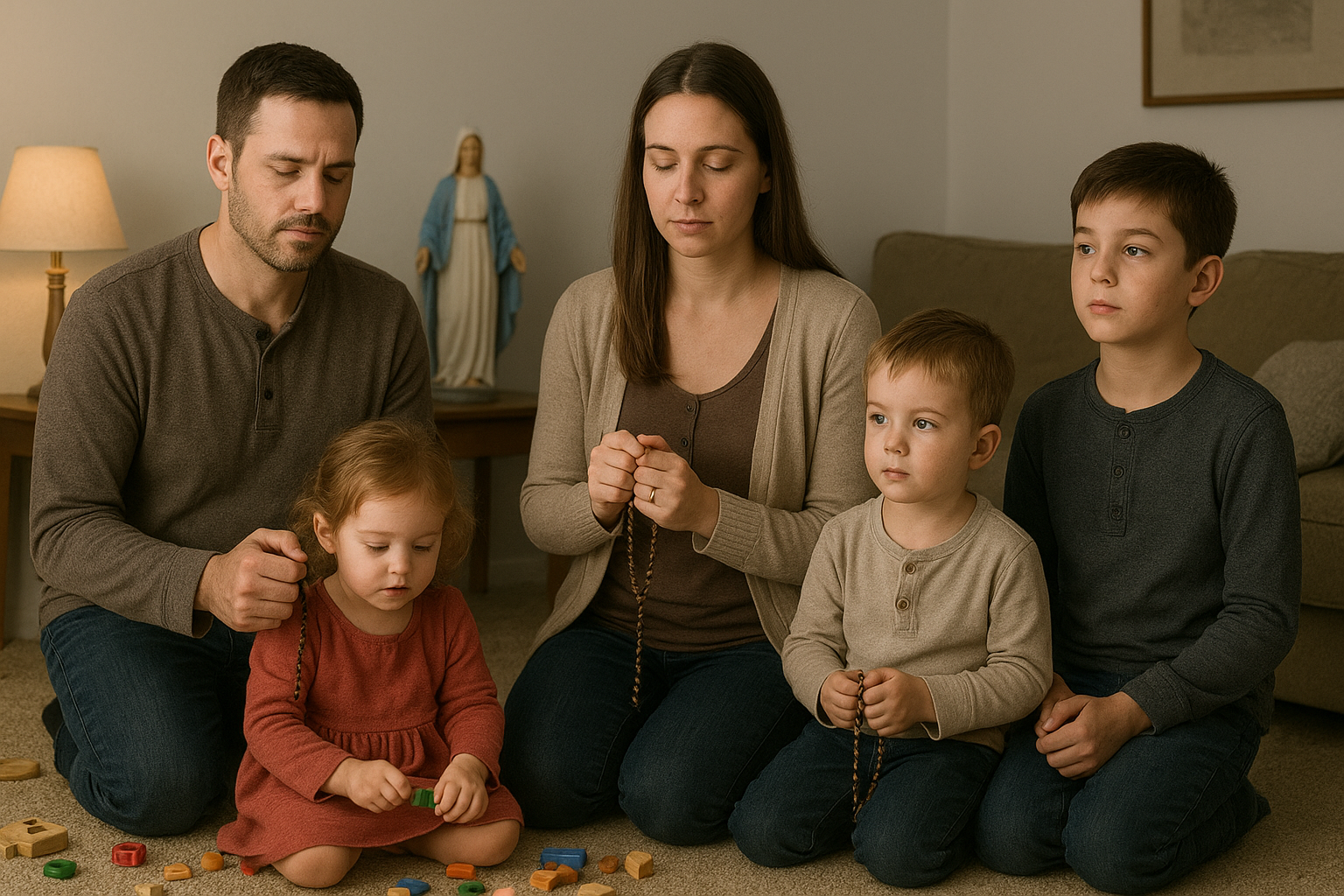
The Rosary is one of the oldest and most enduring devotions in the Catholic Church. It’s woven into the fabric of Catholic life — seen in statues and paintings, hanging from rearview mirrors, wrapped around hands at hospital bedsides, and featured in countless stories of conversion and peace. For centuries, families have turned to this prayer not just as a devotion, but as a rhythm that orders daily life around Christ through the eyes of His Mother.
Praying together as a family is vital. You’ve heard the old saying: “The family that prays together stays together.” It’s cliché but it’s true. Praying together as a family is vital. St. John Paul II wrote in Familiaris Consortio that “only by praying together with their children can a father and mother - exercising their royal priesthood - penetrate the innermost depths of their children’s hearts and leave an impression that the future events in their lives will not be able to efface.“ (Familiaris Consortio, 60). Among all family prayers, the Rosary stands out as a particularly powerful one. John Paul called it “an effect aid to countering the devastating effects of this crisis typical of our age.“ (Rosarium Virginis Mariae, 6).
Also important is that the family does not just pray individually together. Rather, it is important that the family prays as a corporate unit. The Prayers of the Faithful at Mass is a prime example of this. While we each individually are praying for the intentions, as a parish body we are also praying for these intentions. Praying as a corporate body emphasizes the family unit as a whole, instead of merely individuals who are stuck under the same roof together.
And yet, for many parents, praying the Rosary with kids can feel like trying to pray while a small circus breaks out in the living room. The beads tangle, the dog barks, and someone inevitably asks “how many Hail Marys left?” If that sounds familiar, you’re not failing… you’re normal. The Rosary with kids isn’t meant to look like a cloistered monastery. It’s meant to look like your family, with all the beauty and noise that comes with it. In this post, we’ll look at different suggestions for praying the Rosary together as a family. These ideas should be adopted and adapted as befits your particular family situation.
As always, remember that this is a marathon, not a sprint. If you do too much too soon, you’ll burn out. The key is to set aside a little time and slowly work towards your goal. You don’t lift weights Day 1 like you’re a body builder. Instead, you start where you’re at and work your way towards the body - whether physically or spiritually - that you want.
Assign Tasks
Children love to feel responsible and important. They might not love “helping” in the adult sense (it feels too much like work), but they love when their participation matters. Giving each child a specific task during the Rosary can make the prayer feel like their family event rather than just Mom and Dad’s thing. Assigning a task as an important responsibility can get them invested in the prayers. For example my children love to do our family’s Litany of Saints (all of our Baptismal and Confirmation saints), because they know it’s important and special to do at the end of the prayers. They know it’s something special, something entrusted to them. That sense of ownership grows over time, and before long they’ll know the Rosary by heart simply because it’s become part of who they are.
Start small. A five year old can lead the Glory Be. A slightly older child might introduce a decade: “This mystery is the Nativity. We think about when Jesus was born.” Teenagers can take turns leading entire decades, and eventually even offer short reflections before each one.
This structure mirrors the Church herself. Just as each member of the Body of Christ has a role to play, so too does each member of the domestic Church (the family). When children lead, they learn that prayer is not a performance but a participation in something sacred.
Make Intentions Personal
Prayer becomes more meaningful when it connects with real life. The Rosary offers an opportunity to help children see that everything can be brought to God - from world peace to tomorrow’s spelling test. It can be a good way to teach children about the universality of the Church by praying the pope’s intentions for that month, or for the traditional day’s intentions (see this Ramblings to see what those are). But don’t make that the sole focus of the Rosary’s intentions. Instead, balance those with family needs. Ask the kids what’s going on in their lives that they want to pray about: a sick friend, a tough exam, a sad classmate, or even something they’re thankful for.
Just as important as asking your kids for their prayer intentions is to be honest with your own intentions too. Children learn sincerity by watching it. When they hear Mom praying for Dad’s work stress, or Dad praying for Mom’s health, they see prayer as something real, not formal or distant. It’s no longer just “saying prayers.” It’s bringing our collective prayers, as a family, to God. This honesty and vulnerability also brings about honesty and vulnerability in regular family experiences, as well. Importantly, don’t use this as a pivot to punish or control. If a child is honest and vulnerable about a problem with a bully during prayer time, then that’s what they want: prayers. After the Rosary, it’s probably a good idea to ask if they want to talk about it, but don’t make them regret bringing it up by trying to solve their problem or force them to talk if they don’t want to. Just let them know you’re present, and that you’ll continue to pray for this issue for them in your own private prayer.
This habit teaches children that God cares about what happens in their lives. It also shows that prayer isn’t reserved for big problems. It’s for the daily joys and struggles that fill a home. In that way, the Rosary becomes a living conversation with God, woven into the family’s story.
Reflect as a Family on Family Matters
Each mystery of the Rosary can connect beautifully with family life. The Rosary’s structure - moments of joy, sorrow, and glory - mirrors the rhythm of every home life. Some nights bring joy, some days bring sorrow, and some family experiences show the glory of God’s love at the end.
Use that connection to make the mysteries personal. If you’re expecting a new baby, meditate on the Nativity and talk about what it means to welcome new life with joy. If there’s tension among siblings, reflect on the Carrying of the Cross - how Jesus bore his burden out of love, just as we carry our frustrations in love for one another. If your family has just faced a loss, the Glorious Mysteries can offer hope that death is not the end. You might have to spoon feed it to the kids, but that’s okay. As the kids get older, start pushing them to find the lesson for that mystery. What do they want the focus of the meditation to be for that decade’s mystery?
The goal isn’t to force a one-to-one correlation for every mystery, but to let the mysteries open up conversation. Even brief reflections like these invite children to see how Scripture and family life connect. Over time, they’ll come to see that the Rosary isn’t just a string of prayers. It’s a mirror of life itself, sanctified through Christ and His Mother.
Just Pray and Forget
This may be the most important advice of all: just start praying and let go of control. The Rosary is a school of patience and grace, for parents as much as for children.
Your kids might wiggle, whisper, wander, or play. That’s okay. Keep praying anyway. Over time, their curiosity will grow: “Why are Mom and Dad so focused? Why do they keep doing this every night/Sunday/etc.?” Little by little - days, weeks, months - they’ll draw closer. Sometimes to pray, sometimes just to watch. Let it happen naturally. This method integrates the prayer into your family life, instead of suspending family life for the prayer. Integrating it makes it integral to your family, whereas suspending family life for the prayer makes it seem like the prayer is something separate and apart.
If a child has a small task, call them over gently when it’s their turn. If they join in, great. If not, keep praying with joy and not frustration. What you’re teaching them isn’t just the words of the Rosary, but the constancy of prayer! If every Rosary becomes a battle, they’ll associate prayer with conflict. But if it remains peaceful - even amid the chaos - they’ll remember the calm and warmth that surrounded it.
And as they grow, discern when it’s time to expect a little more focus. Each child is different. One might sit still and pray all five decades, another might keep trying to turn the Rosary into a “holy whip.” That’s family life. What matters most is that they see the Rosary not as an intrusion into family life, but as part of its heartbeat. If you’re not sure where your child is, ask someone that knows them! Friends from church will be happy, and probably feel honored, that you’re asking them if they think your child is old enough to do X at prayer time.
Conclusion
Family prayer isn’t about perfection. It’s about presence. The Rosary doesn’t require angelic silence or perfectly recited Hail Marys. It requires love: a family willing to sit together before God, even for a few minutes, and lift their hearts as one. That effort sanctifies the ordinary. It transforms noisy living rooms into chapels of grace and reminds everyone that holiness grows in small, faithful steps.
If you keep at it - one bead, one night, one mystery at a time - your children won’t just remember the words of the Rosary. They’ll remember that prayer was part of who you were as a family. That memory, sealed in grace, will stay with them long after the toys are gone and the house is quiet again.
