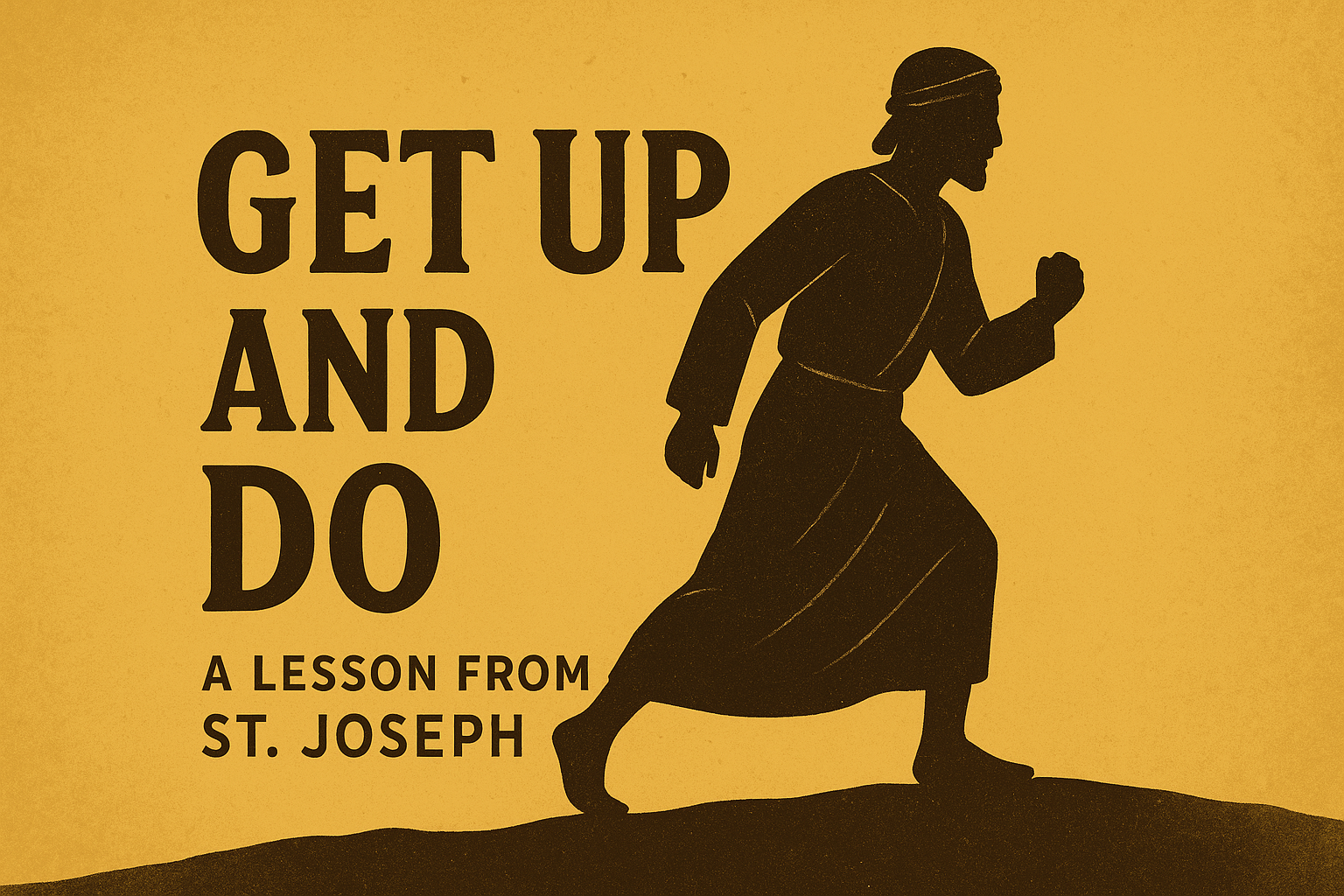
This Sunday’s celebration of the Holy Family invites us to think about many things: the relationship and roles of husbands and wives, the relationship and roles of children and parents, and the relationship and roles of the Holy Family themselves. During this Christmas season, too, we often hear some about St. Joseph in the readings, yet many homilies don’t spend much time inviting meditation on him.
When we first encounter St. Joseph in the Gospels, he is in medias res (in the middle of the action): he’s discovered that Mary, his wife, is pregnant… and not by him.(1) (Matthew 1:18-25). He is contemplating how to separate from her such that her life is not in danger, and yet he turns 180 degrees and brings her into his household anyways. Later, Joseph’s new family is threatened as King Herod prepares to kill an infant Jesus. Joseph uproots his family and leaves. (Matthew 2:13-15). Eventually returning, he still is unable to return home, and instead he and the Holy Family settle in Nazareth in Galilee. (Matthew 2:19-23). For any man, this would be cause for confusion, anger, and despair. Yet in those moments, the remarkable thing about Joseph is not what he says but what he does. So many people in Scripture give us great statements of faith, poetry, and prose. Luke’s Gospel alone provides the three main canticles of the Divine Office - the Benedictus, the Magnificat, and the Nun Dimittis. Yet, one of the most important characters in Scripture says nothing. Throughout the entire New Testament Joseph never utters a single word. He listens, then acts.
This silence, far from indicating passivity or lack of interest, is the mark of a man completely attuned to the will of God. St. Joseph always commits the same actions. When he is told to take Mary as his wife, Joseph rose “and did as the angel of the Lord commanded him.“ (Matthew 1:24). When he is told to flee to Egypt, he “rose and took the child and his mother by night and departed to Egypt.“ (Matthew 2:14). And, finally, when Joseph was told to return home, he “rose and tool the child and his mother and went to the land of Israel.“ (Matthew 2:20-21).
Each time God speaks, St. Joseph simply gets up and obeys. He does not question, he does not inquire, he does not doubt, he does not express confusion or hostility or despair. In his silence, Joseph proclaims the loudest sermon in the Gospels: holiness consists not in eloquent words but in immediate, trusting obedience. Let’s explore this witness further.
The Silent Saint of Action
Silence is not absence. For St. Joseph, it in fact is presence - a space in which God’s word can be heard and obeyed. Joseph does not talk until God speaks. He does not act first and wait for God to catch up. Instead, by being silent, Joseph makes room for God to be heard and obeyed. Today we are inundated with commentary, noise, self-expression, and influence. Joseph’s quiet faith is scandalous today - indeed, it’s countercultural. He acts in complete faith, trusting that the God who calls him for a special purpose will also guide him.
St. John Paul II wrote that St. Joseph’s life was a “pilgrimage of faith.“ (Redemptoris Custos, 6). Joseph believes against all appearances, and faith necessarily takes a central place in his life. The angel’s message is humanly unreasonable - that the child conceived in Mary “is from the Holy Spirit“ (Matthew 1:20b) - yet Joseph accepts this mystery without hesitation. His faith doesn’t rely on comprehension but rather on trust.
St. Joseph’s obedience reveals something profound about the nature of faith itself: faith is not merely an intellectual asset to propositions but is a lived reality. Joseph’s life was a lived response of his whole person to God’s call. Faith and action are inseparable. Joseph’s faith is verified in movement: rising, taking, going, and doing.
Joseph embodies James 2:17: “so also faith by itself, if it does not have works, is dead.“
Joseph and the Theology of Obedience
Obedience has become an uncomfortable word, especially in spirituality. We don’t like to obey. Whenever I ask my children to do something, the first question is going to be “why?“ This was what Zechariah said when Gabriel announced to him the coming of his son John the Baptist: “How shall I know this?“ (Luke 1:18). In fairness to my kids, they usually first say “Yes, sir“ followed by the question of “why?“ Still, there is a hesitancy in our lives - even when we ultimately say yes to God - when we are called to obedience. Mary’s obedience - her fiat - is still accompanied by a (holy) desire to know how to help at the Annunciation. (Luke 1:34). This is not the case with St. Joseph. Joseph needs to know nothing else than that God wills it. At that point, he arises and obeys.
Obedience is always the posture of love. Jesus himself became “obedience to the point of death, even death on a cross.“ (Philippians 2:8). To obey is to trust that the God who commands loves us more deeply that we even love ourselves. Joseph models this perfectly. His obedience flows from a heart that listens first. The Greek word hupakouo (to obey) literally means “to listen under.“ (Strong’s Greek). Listening is not just an important part of the Christian life: it is necessary. Joseph listens beneath the noise of circumstance and fear, beneath the pressures of social judgment, and he hears the still, small voice of God. And when Joseph hears it, he moves - without hesitation, without question, without even asking how God might want him to go about it.
Pope Benedict XVI writes in Jesus of Nazareth: The Infancy Narratives that St. Joseph was a just man because he “maintains living contact with the word of God.“ This is the key to his sanctity. Righteousness, in the Biblical sense, is not moral perfection, but right relationship: living in harmony with God’s will. Joseph’s life is oriented, listening to the Word of God. It is oriented when God tells him to take Mary into his home. It is oriented again when Jesus is told to take Mary and Jesus to safety in Egypt. It is oriented yet again when God tells Joseph to return to Israel. At every stage, Joseph allows God to set the goal and to take care of the plans along the way. Joseph doesn’t wait for “the time to be right.“
In doing so, St. Joseph embodies the spiritual principle that true freedom lies not in doing whatever we want, but it lies in surrendering to God’s will. Importantly, Benedict writes in the same book that “God’s will is not a law imposed on him from without, it is ‘joy.‘“ Joseph is the opposite of Adam, whose disobedience brought death. Joseph’s obedience - his quiet, consistent, uncomplaining obedience - becomes a participation in the redemption of the world.
The Hidden Life and the Power of Humility
This silent obedience is part and parcel with St. Joseph’s clear humility. Joseph’s story is largely hidden. He appears only briefly in the Gospels, and then he disappears without fanfare. Yet in that hiddenness lies a profound theological truth. God entrusts his greatest treasures - Jesus and Mary - to a man whose holiness is silent and unseen. In a culture obsessed with visibility and recognition - with an incessant pursuit of more likes and hearts and followers - Joseph teaches that sanctity is not measured by public acclaim; it is by fidelity to the ordinary. Joseph is a carpenter, a laborer, providing for his family day by day. But even in that hustle and bustle, he remained silent, waiting for the Lord to speak.
Pope Francis picks up on this in his Apostolic Letter Patris Corde (With a Father’s Heart). Francis writes “In every situation, Joseph declared his own ‘fiat,‘ like those of Mary at the Annunciation and Jesus in the Garden of Gethsemane.“ (Patris Corde, 3). This is the heart of Christian discipleship: to say yes, again and again, to whatever God asks, even when we do not understand.
The hierarchy, as well as the laity, can learn a lot from St. Joseph in this regards. Like Mary, the Church does carry Jesus to the world, and brings him physically into the world through the Eucharist. However, the Church also needs to be more like St. Joseph: a silent witness to the Gospel, who listens to God, then gets up and does it.
Joseph as the Mirror of Christian Vocation
We are all called to imitate St. Joseph’s readiness to act. When God speaks - through Scripture, conscience, Holy Spirit, or the Church - our task is not to debate, question, seek clarification, or plan. Our task is to get up and do it. This does not mean purposefully blind obedience, as if we merely sit there waiting for the Lord to send an angel to speak to us. God does not want our obedience to be robotic, like we are mere pack animals Joseph’s actions came not out of a life of ignorance or naivety. His obedience was born from a life of thought, prayer, and discernment. Once the truth was known - once he was told what to do - Joseph wasted no time. He gets up and goes. We need to seek the will of God, particularly by seeking to be capable of understanding and hearing his voice when it speaks. This comes from reading Scripture, living a liturgical life, and engaging in conversation with God.
For us Christians today, this kind of faith requires both courage and surrender. We often want clarity before we act. Even more, we want to play a role in the decision-making process. We want ownership. In reality, we want control. But God’s invitations usually come wrapped in uncertainty. Joseph is never given the full plan. Rather, he’s only given the next step. “Take Mary as your wife,“ “flee to Egypt,“ “go to the land of Israel.“ Step by step, obedience becomes revelation, but it is not born from revelation. That would take away his faith.
Silence that Speaks
St. Joseph’s silence is not empty - it’s contemplative. It mirrors the silence of God in so many moments of Salvation History. Like the silence before the dawn of Creation, before the Incarnation, and before the Resurrection, Joseph’s silence allows God’s Word to take flesh. His silence is like a sanctuary in which the mystery of God unfolds unhindered.
In an age of constant and incessant speech, we risk drowning out the Divine Whisper. Joseph invites us to recover the discipline of silence - not merely the absence of noise, but a space for God’s voice. Silence in prayer. Silence in decision-making. Silence before the mystery of suffering. Like Joseph, we can learn to hear and then act.
Rise and Do the Will of God
St. Joseph’s greatness lies in his silence. He hears, he rises, and he acts. His faith is not spectacular but steadfast. His virtue is not dramatic but deep. Through his obedience, the plan of salvation moves forward - quietly, efficiently, and beautifully.
Every Christian life, in some way, is called to mirror St. Joseph. When God prompts our hearts - whether to forgive, to serve, to change, or to trust - we can respond with Joseph’s simplicity: rise and do. The Church honors him as the Patron of the Universal Church, in part because he embodies the Church’s own vocation to hear God’s word and put it into action. Jesus says that “My mother and my brothers are those who hear the word of God and do it.“ (Luke 8:21).
In St. Joseph’s silent obedience, we glimpse the perfection of discipleship: a heart attuned to God’s will, hands ready to work, and a head content to remain in silent agreement. Joseph’s life asks us one simple question. Not “Do you understand?“ but “Will you obey?“
And perhaps, like Joseph, our greatest act of faith will not be found in what we say or write, but rather in what we do when God calls.
Further Resources
Here is some additional reading on St. Joseph from the popes.
Patris Corde (With a Father’s Heart)- Pope Francis, 2020
Redemptoris Custos (Guardian of the Redeemer)- Pope St. John Paul II, 1989
Quamquam Pluries (On Devotion to St. Joseph)- Pope Leo XIII, 1889
Quemadmodum Deus (Just as God)- Sacred Congregation of Rites on behalf of Pope Pius IX, 1870
(1) We often talk about Joseph and Mary being betrothed. That’s not strictly accurate. At this time, while there were two steps of the marriage process, they were still legally married. In fact, this is why Joseph needed to “divorce her quietly.“ (Matthew 1:19). Joe Heschmeyer has a convincing argument about this. He presents the argument here, and discusses a rebuttal here.
