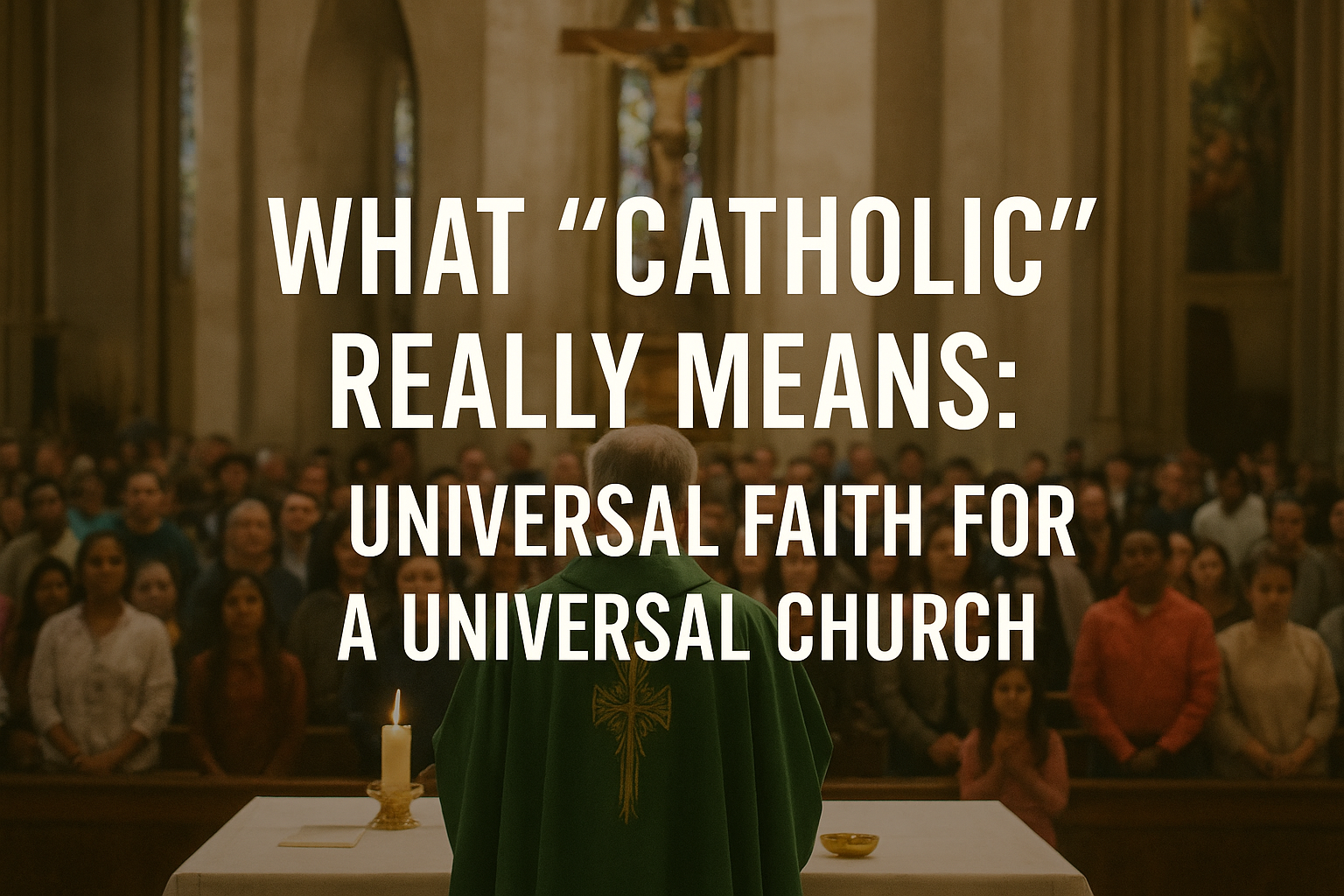
When people hear the word “catholic," many immediately think of the denomination of Christianity headquartered in Rome, with the Pope as its visible leader. While that’s true, it only scratches the surface. The word “catholic” comes from the Greek katholikos, meaning “according to the whole” or “universal.” From the earliest days of the Church, Christians used this word to describe the faith that was not bound by tribe, nation, or culture, but was meant for everyone, everywhere, and at all times. Indeed, the term “catholic“ signifies one of the four, visible marks of what the true Church is: one, holy, catholic, and apostolic. The Catechism of the Catholic Church explains: “The Church is catholic in a double sense… because Christ is present in her… [and] because she has been sent out by Christ on a mission to the whole of the human race.” (CCC, 830-831).
In this post, we’ll explore what it means that the Church is catholic, as well as what we mean when we call her Catholic. We’ll look at the theological and historical meaning of the word, trace its use in Scripture and the early Church, and then reflect on how Catholics today can live out this universal dimension of the faith in their daily lives.
The Roots of the Word Catholic
The term katholikos is a compound of kata (“according to”) and holos (“whole”). In other words, something is “catholic” if it pertains to the fullness or wholeness of a reality. The first surviving use of the term to describe the Church comes from St. Ignatius of Antioch, who wrote around the year 110: “wherever Jesus Christ is, there is the Catholic Church.” (Epistle of Ignatius to the Smyrnaeans, 8). For Ignatius, the “Catholic Church” was not a local sect or community, but the whole body of believers united with Christ and the bishops in communion.
This universality was already hinted at in Scripture. Jesus commissions His disciples to “make disciples of all nations” (Matthew 28:19), and St. Paul insists that in Christ “there is neither Jew nor Greek, there is neither slave nor free, there is no male and female.” (Galatians 3:28). The mission of the Church was never intended to be provincial. From its foundation, it bore a universal scope.
Catholic as Fullness of Faith
The Church is “catholic” not only because it is spread throughout the world, but because it possesses the fullness of Christ’s truth and the means of salvation. As the Catechism states: “The Church was, in this fundamental sense, catholic on the day of Pentecost and will always be so until the day of the Parousia.” (CCC, 830). This fullness means that the Church holds nothing back: the entirety of divine revelation, the sacraments, apostolic succession, and unity with Christ are present within her.
The Fathers of the Church often contrasted this fullness with heresies, which by definition are partial. St. Cyril of Jerusalem in the fourth century said the Church is called “catholic” because “it teaches universally and completely one and all the doctrines which ought to come to men’s knowledge, concerning this both visible and invisible, heavenly and earthly.” (Catechetical Lecture, 18:23). Catholicity thus points not merely to breadth (geography) but also to its depth (doctrine).
So the Church is universal, it is “catholic,“ speaks to the universality and wholeness of the truth found within her.
Catholic as Mission to the Whole World
The Church is “catholic” also in the sense that she is sent to all peoples for all times. The universality of the Church - in both a geographic and a temporal sense - is a direct consequence of the universality of Christ’s redemption. “He is the propitiation for our sins, and not for ours only but also for the sins of the whole world.” (1 John 2:2). The Second Vatican Council reaffirmed this teaching when it taught “[a]ll men are called to be part of this catholic unity of the people of God.” (Lumen Gentium, 13).
This global mission remains a living reality today. The Church is present on every continent, preaching the Gospel in thousands of languages. Every Sunday, Catholics around the world celebrate the same Eucharist, a sign that this faith is not bound by geography or culture or time but transcends both.
The Church, therefore, is for all peoples at all times in all places. It is as universal as it can be.
Living Out the Universality of the Church
How does this universality touch the life of an ordinary Catholic? First, it calls us to recognize that our faith is bigger than our parish, diocese, or even our nation. While the Church exists in a special way in your particular country, diocese, and even parish, it also exists as a whole. To be Catholic is to belong to a family that spans centuries and continents. When you attend Mass, you are united not only with those in the pews around you, but with the Church in Africa, Asia, Europe, and beyond, with the Church of Peter and Paul, Augustine, Thomas Aquinas, and J.R.R. Tolkien, and with the Church in heaven and on earth.
Second, living out Catholicity means welcoming the “whole” of the faith. We do not pick and choose only the teachings that suit us. A truly Catholic life embraces the fullness of the Church’s teaching, even when it challenges us. St. Augustine once said: “Your evasions are met on every side. You ought to say plainly that you do not believe the gospel of Christ. For to believe what you please, and not to believe what you please, is to believe yourselves, and not the gospel.” (Contra Faustum, Book XVII, 3).
Finally, Catholic universality calls us to hospitality and mission. In our homes and parishes, we can embody this universality by making space for those who are different from us, whether culturally, socially, or spiritually. The Eucharist itself is a foretaste of the heavenly banquet in which “people will come from east and west, and from north and south” will sit at table in the Kingdom of God. (Luke 13:29).
Conclusion
The word “catholic“ does not describe a mere denomination or just another organization in a loose confederation of Christian thought. To call the Church “catholic” is not merely to identify a denomination. It is to proclaim that the Church is universal in scope, complete in teaching, and open to all. From the time of the Apostles through the witness of the Church Fathers, the Church has understood herself to be the living body of Christ offered to the whole world.
As Catholics, embracing this universality means more than just belonging to a global institution. It means allowing the “whole” of the Gospel to shape our lives, reaching beyond our comfort zones, and recognizing that the Body of Christ is larger, deeper, and more beautiful than we can imagine. To be Catholic, then, is to live “according to the whole” - a faith that is for everyone, everywhere, always.
